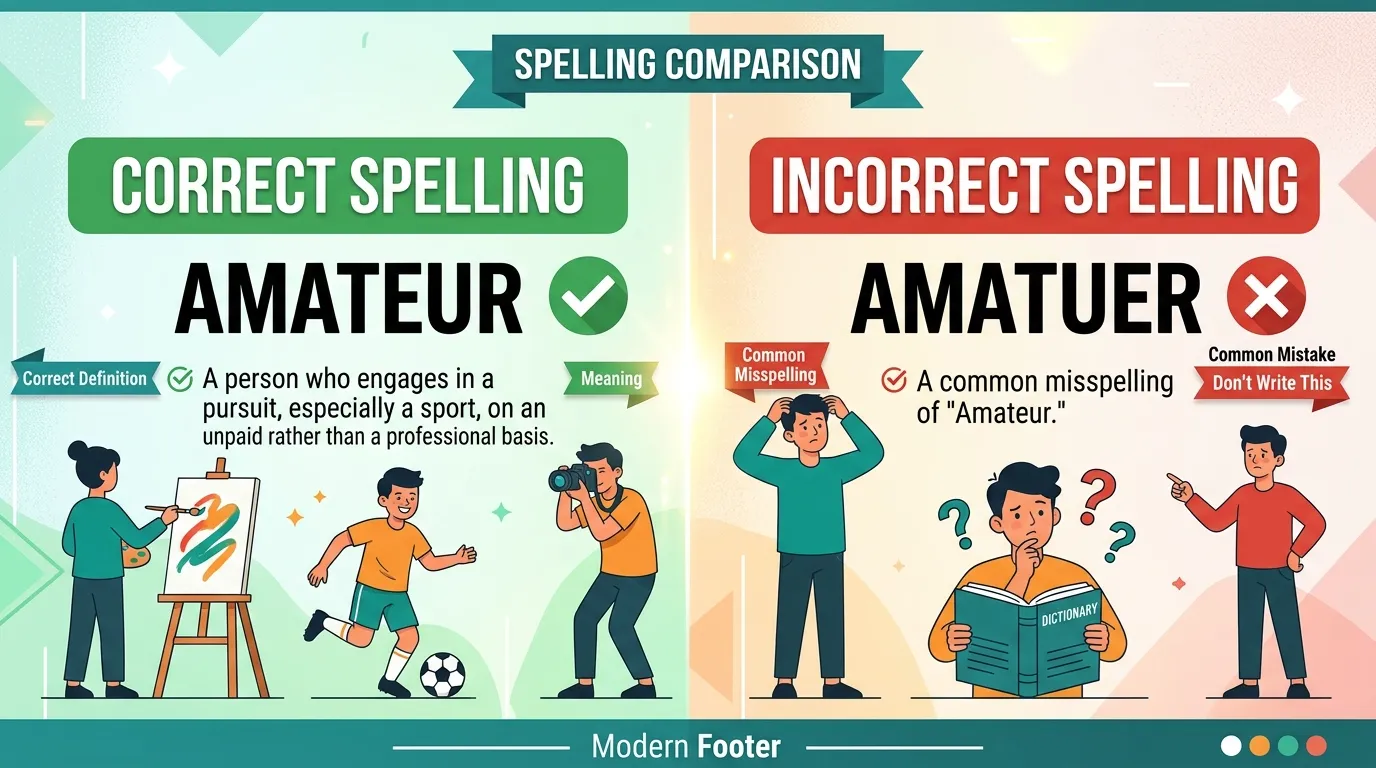
If you’ve searched for amateur vs amatuer, you’re probably wondering whether both spellings are acceptable or if one is simply a mistake. The short answer is easy: “amateur” is the correct spelling, while “amatuer” is a common misspelling.
Even fluent English speakers frequently mix up these two spellings because the letters “eu” in amateur don’t follow the spelling patterns found in many everyday English words. Spell-checkers often catch the error, but it still appears in emails, resumes, social media posts, blogs, sports articles, and even business documents.
In this guide, you’ll learn exactly why people confuse these spellings, how to remember the correct one, how to pronounce the word correctly, where it came from, how to use it naturally in different situations, and how to avoid one of the most common English spelling mistakes. Whether you’re a student, writer, blogger, professional, or English learner, this complete guide will help you use amateur confidently every time.
Quick Answer
| Question | Answer |
|---|---|
| Is amateur correct? | ✅ Yes |
| Is amatuer correct? | ❌ No |
| Which spelling should you use? | Amateur |
| Why is amatuer common? | People accidentally reverse the letters e and u. |
Correct:
- amateur photographer
- amateur athlete
- amateur artist
Incorrect:
- amatuer photographer
- amatuer athlete
- amatuer artist
Is It Amateur or Amatuer?
The only correct English spelling is amateur.
The spelling amatuer is simply a spelling error. It is not recognized by standard English dictionaries and should never appear in formal writing.
Although millions of people accidentally type amatuer, especially while typing quickly, it remains incorrect.
Think of it this way:
✅ amateur = correct
❌ amatuer = incorrect
What Does Amateur Mean?
An amateur is someone who participates in an activity because they enjoy it rather than because they earn money doing it professionally.
The word can also describe someone who is still learning and has not yet reached professional skill.
Dictionary Style Definition
Amateur (noun)
A person who engages in an activity for pleasure instead of as a profession.
Amateur (adjective)
Relating to someone who is not professionally trained or paid.
Why Do People Misspell Amateur as Amatuer?
Several reasons make this word difficult to spell.
The Letter Order Is Unusual
Many English words don’t place e before u in this pattern.
Correct:
amateur
Many people incorrectly write:
amatuer
The brain naturally swaps the letters.
Pronunciation Doesn’t Clearly Reveal the Spelling
Most speakers pronounce it something like:
AM-uh-chur
Because the pronunciation doesn’t clearly sound like eu, many writers guess the spelling incorrectly.
Typing Too Quickly
Fast typing often leads to transposed letters.
Examples:
- recieve instead of receive
- wierd instead of weird
- amatuer instead of amateur
Muscle Memory
If someone repeatedly types the wrong version, their fingers begin reproducing the same mistake automatically.
How to Pronounce Amateur
American English
/ˈæməˌtʃʊr/
Approximate pronunciation:
AM-uh-chur
British English
/ˈæmətə(r)/
Approximate pronunciation:
AM-uh-tuh
Although pronunciation differs slightly, the spelling remains exactly the same.
Amateur as a Noun
When used as a noun, it refers to a person.
Examples:
- She is an amateur painter.
- He’s an amateur astronomer.
- The tournament welcomes amateurs.
- Many amateur photographers entered the contest.
- The amateur surprised everyone with his talent.
Amateur as an Adjective
The word also functions as an adjective.
Examples:
- amateur boxing
- amateur sports
- amateur theater
- amateur photography
- amateur competition
Example sentences:
- They joined an amateur drama club.
- Amateur musicians performed beautifully.
- The city hosts several amateur tournaments.
Amateur vs Professional
| Amateur | Professional |
|---|---|
| Participates for enjoyment | Earns income |
| May lack formal training | Usually trained |
| Learning or practicing | Experienced |
| Often unpaid | Usually paid |
| Hobby or passion | Career |
Example:
“My sister is an amateur photographer, but my uncle is a professional photographer.”
Does Amateur Always Mean Inexperienced?
No.
This is one of the biggest misconceptions.
Many amateurs are extremely skilled.
Examples include:
- Olympic athletes
- Volunteer musicians
- Hobby photographers
- Chess champions
- Competitive runners
Historically, many Olympic athletes competed as amateurs.
So amateur does not automatically mean “bad.”
It simply means someone is not professionally employed in that activity.
Can Amateur Be an Insult?
Sometimes.
Depending on context, calling someone an amateur may imply:
- lack of experience
- poor quality
- unprofessional work
- beginner-level skills
Example:
“That editing looks amateur.”
Here the speaker is criticizing the quality.
However, in other contexts, the word is completely neutral.
Example:
“She belongs to an amateur orchestra.”
There is no negative meaning.
Amateur vs Beginner
These words are similar but not identical.
| Amateur | Beginner |
|---|---|
| Not paid professionally | New to learning |
| May be highly skilled | Usually inexperienced |
| Can compete seriously | Just starting |
Someone can be an amateur for twenty years and still never become a professional.
Amateur vs Hobbyist
These words overlap but differ slightly.
| Amateur | Hobbyist |
|---|---|
| Often participates competitively | Usually participates for enjoyment |
| May train seriously | Usually casual |
| Can enter competitions | May simply enjoy the hobby |
Amateur vs Novice
A novice is someone with very little experience.
An amateur simply isn’t a professional.
Someone may be:
- an amateur with 30 years of experience
- a novice with only one week of experience
Amateur vs Rookie
A rookie is someone in their first season or first job.
An amateur may have decades of experience.
Example:
A retired engineer who paints every weekend is an amateur artist—not a rookie.
Common Collocations with Amateur
Native English speakers frequently use these combinations.
Sports
- amateur athlete
- amateur golfer
- amateur boxer
- amateur league
- amateur championship
Arts
- amateur artist
- amateur actor
- amateur musician
- amateur photographer
- amateur filmmaker
Science
- amateur astronomer
- amateur scientist
- amateur historian
Technology
- amateur programmer
- amateur drone pilot
- amateur radio operator
Common Expressions Using Amateur
Popular phrases include:
- amateur hour
- amateur mistake
- amateur effort
- amateur competition
- amateur sports
- amateur performance
- amateur photographer
- amateur artist
What Does “Amateur Hour” Mean?
The expression amateur hour is informal.
It describes a situation where people make obvious mistakes because they lack experience.
Example:
“This meeting is turning into amateur hour.”
The phrase is often humorous but can also sound insulting.
Etymology of Amateur
The word entered English through French.
Origin:
French amateur
Meaning:
“lover of”
Ultimately derived from the Latin word amator, meaning “lover.”
Originally, an amateur was someone motivated by love or passion rather than financial reward.
That meaning still survives today.
Synonyms of Amateur
Depending on context:
- hobbyist
- enthusiast
- nonprofessional
- unpaid participant
- learner
- trainee
- beginner
- novice
- newcomer
- volunteer
Antonyms of Amateur
Common opposites include:
- professional
- expert
- specialist
- authority
- veteran
- master
- consultant
- practitioner
Real-World Examples
Sports
She competed as an amateur before turning professional.
Photography
My father is an amateur photographer who takes incredible wildlife pictures.
Music
The festival welcomes both professional and amateur musicians.
Writing
He’s an amateur novelist working on his first book.
Astronomy
Thousands of amateur astronomers contributed observations during the eclipse.
Formal vs Informal Usage
| Context | Appropriate? |
|---|---|
| Academic writing | ✅ Yes |
| Journalism | ✅ Yes |
| Business writing | ✅ Yes |
| Technical writing | ✅ Yes |
| Sports reporting | ✅ Yes |
| Blogs | ✅ Yes |
| Social media | ✅ Yes |
| Everyday conversation | ✅ Yes |
The word is accepted in virtually every style of English.
American vs British English
Good news:
There is no spelling difference.
| American English | British English |
|---|---|
| amateur | amateur |
Unlike:
- color / colour
- organize / organise
- center / centre
The spelling amateur remains identical worldwide.
Common Mistakes
Incorrect Letter Order
❌ amatuer
✅ amateur
Assuming Amateur Means Bad
Incorrect:
Every amateur lacks skill.
Correct:
Many amateurs possess expert-level ability.
Using Amateur Instead of Beginner
Incorrect:
“I’m an amateur driver.”
Better:
“I’m a beginner driver.”
Unless you’re comparing professional and nonprofessional drivers, “beginner” is clearer.
Awkward vs Natural Examples
| Awkward | Natural |
|---|---|
| He’s an amatuer photographer. | He’s an amateur photographer. |
| I’m amatuer at coding. | I’m an amateur programmer. |
| She plays amatuer tennis. | She plays amateur tennis. |
| They joined an amatuer club. | They joined an amateur club. |
Memory Trick
Remember this phrase:
“AmatEUr has EU together.”
The letters EU stay together in the middle.
Visual reminder:
A M A T E U R
Never switch them.
How Spell Checkers Handle It
Most grammar and spelling tools automatically correct:
❌ amatuer
to
✅ amateur
However, proofreading remains important because:
- autocorrect can be disabled
- scanned documents may contain errors
- OCR software sometimes misreads letters
Tips for Writers
When writing professionally:
- Always use amateur.
- Double-check resumes and cover letters.
- Proofread blog posts before publishing.
- Use spell-check as a backup, not your only editor.
- Learn the EU letter order.
Usage in Different Writing Styles
Academic Writing
Correct:
The study included both amateur and professional athletes.
Journalism
Correct:
Several amateur golfers qualified for the championship.
Business Writing
Correct:
The workshop welcomes amateur photographers.
Technical Writing
Correct:
The software is suitable for both amateur and experienced users.
Sports Writing
Correct:
The amateur league begins next month.
Blogging
Correct:
This guide helps amateur gardeners grow healthier vegetables.
Casual Conversation
Correct:
I’m just an amateur cook.
Should You Ever Use “Amatuer”?
No.
There are no recognized situations where amatuer is considered acceptable English.
Whether you’re writing:
- an email
- an article
- a resume
- a research paper
- a blog
- a social media caption
- a novel
the correct spelling is always:
amateur
Key Differences at a Glance
| Feature | Amateur | Amatuer |
|---|---|---|
| Correct spelling | ✅ Yes | ❌ No |
| Found in dictionaries | ✅ Yes | ❌ No |
| Accepted in formal writing | ✅ Yes | ❌ No |
| Used worldwide | ✅ Yes | ❌ No |
| Recommended | ✅ Always | ❌ Never |
Frequently Asked Questions
Is amatuer a real English word?
No. Amatuer is a misspelling of amateur and is not accepted in standard English.
Which spelling is correct: amateur or amatuer?
The correct spelling is amateur.
Why do people spell amateur incorrectly?
People often reverse the letters e and u because the spelling is unusual and the pronunciation doesn’t clearly reveal the letter order.
Is amateur an insult?
Not necessarily. It can simply describe someone who is not a professional. In some contexts, however, it may be used to criticize a lack of skill.
Is amateur used in American English?
Yes. Amateur is the standard spelling in American English.
Does British English spell amateur differently?
No. British English uses the same spelling: amateur.
Can an amateur be highly skilled?
Absolutely. Many amateurs develop exceptional skills while participating for personal enjoyment rather than income.
What is the opposite of amateur?
The most common opposite is professional, though expert may also fit depending on the context.
How can I remember the correct spelling?
Remember that the letters “EU” stay together in the middle: amatEUr.
Should I correct amatuer if I see it in a document?
Yes. In professional, academic, journalistic, and everyday writing, it should always be corrected to amateur.
Conclusion
The debate over amateur vs amatuer has a clear answer: amateur is the only correct spelling, while amatuer is a common but incorrect letter transposition. Although the unusual EU sequence causes many writers to make mistakes, remembering that those two letters always stay together can help you avoid the error.
Beyond spelling, amateur is a valuable word that describes someone who pursues an activity for passion rather than pay. It does not automatically mean unskilled or inexperienced. In fact, many amateur athletes, artists, musicians, photographers, and hobbyists demonstrate remarkable expertise.
For American, British, international, academic, business, journalistic, technical, sports, blogging, and casual writing alike, the recommendation is simple: always use amateur. By choosing the correct spelling consistently and understanding its meaning and usage, you’ll write with greater confidence, clarity, and professionalism.


