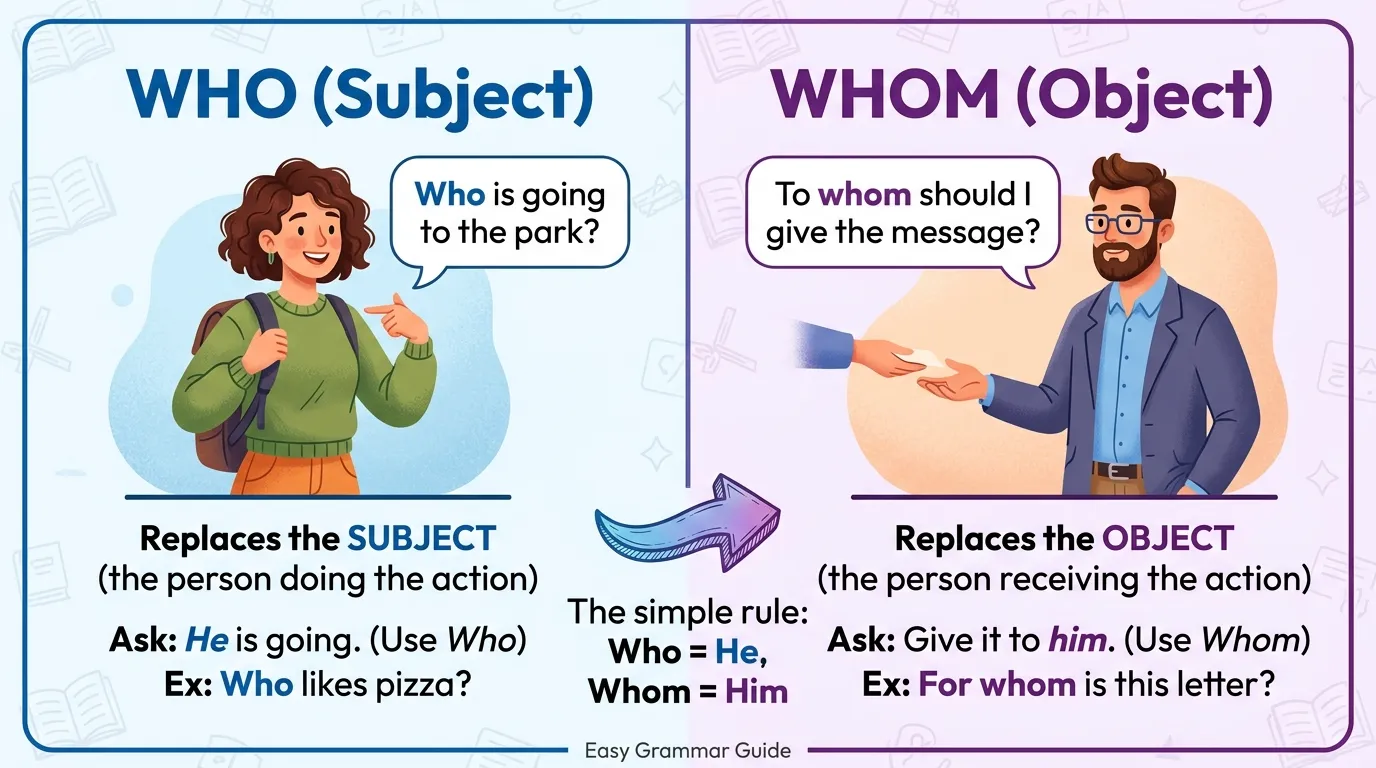
Who vs. whom is one of the most common grammar questions in English. Both words are used to refer to people, but they have different grammatical roles. The easiest way to understand the difference is to remember that who is used as a subject, while whom is used as an object.
For example:
Who called you?
Here, who is doing the action.
Whom did you call?
Here, whom receives the action.
Although whom is still correct in formal English, it is less common in everyday conversation. Many native speakers simply use who in informal situations.
What Is the Difference Between Who and Whom?
The basic rule is:
- Who = subject
- Whom = object
Think about the difference between he and him.
If you can replace the word with he, use who.
If you can replace it with him, use whom.
Example
Who is coming?
You can say:
He is coming.
Therefore, who is correct.
Now consider:
Whom did you invite?
You can say:
I invited him.
Therefore, whom is correct.
Who: The Subject Pronoun
Who is used when the person is performing the action.
Examples
Who broke the window?
Who sent this message?
Who wants some coffee?
Who is at the door?
In each example, who is the subject.
Whom: The Object Pronoun
Whom is used when the person receives the action or follows a preposition in formal grammar.
Examples
Whom did you invite?
Whom did she call?
To whom should I send the email?
Whom are you talking about?
In these examples, whom functions as an object.
The He/Him Trick
One of the easiest ways to decide between who and whom is the he/him test.
Use WHO if you can answer with HE
Who called you?
He called me.
So:
✅ Who called you?
Use WHOM if you can answer with HIM
Whom did you call?
I called him.
So:
✅ Whom did you call?
This simple trick works in many situations.
Who vs. Whom Examples
| Sentence | Correct Word | Reason |
|---|---|---|
| Who called me? | Who | Subject |
| Whom did you call? | Whom | Object |
| Who is coming? | Who | Subject |
| Whom did she invite? | Whom | Object |
| Who wrote the article? | Who | Subject |
| To whom did you speak? | Whom | Object |
Who vs. Whom After Prepositions
In formal English, whom is commonly used after a preposition.
Examples:
To whom should I address the letter?
With whom are you traveling?
From whom did you receive the message?
For whom is this gift?
However, everyday English often moves the preposition to the end and uses who.
For example:
Formal:
To whom are you speaking?
Informal:
Who are you speaking to?
Both are understandable, but the first sounds more formal.
Who vs. Whom in Questions
Questions are where people most often become confused.
Who did you see?
In formal traditional grammar, whom is preferred because the person is the object:
Whom did you see?
However, Who did you see? is extremely common in modern conversational English and is widely accepted in informal usage.
Who called you?
Here, who is clearly correct because the person is the subject.
Who called you?
Not:
❌ Whom called you?
Who vs. Whom in Formal Writing
Whom is more likely to appear in formal writing, especially after prepositions.
Examples:
To whom it may concern
The applicant whom we interviewed was highly qualified.
The professor whom the students contacted responded quickly.
In casual communication, people often use who instead.
Who vs. Whom in Everyday Conversation
In modern spoken English, who is much more common than whom.
For example:
Who did you meet?
This sounds completely natural in conversation.
Although traditional grammar may recommend:
Whom did you meet?
many speakers consider who more natural in informal contexts.
This does not mean whom is wrong. It simply means English usage has changed over time.
Who and Whom in Relative Clauses
Both words can introduce relative clauses.
Who
The woman who called me is my teacher.
Here, who is the subject of called.
Whom
The woman whom I called is my teacher.
Here, whom is the object of called.
A useful comparison:
The man who helped me was kind.
He helped me.
The man whom I helped was kind.
I helped him.
Who vs. Whom in Professional Writing
In professional writing, choosing between who and whom depends on the sentence and the level of formality.
Use who when it is the subject:
The employee who completed the project received an award.
Use whom when it is the object:
The employee whom we hired has five years of experience.
However, rewriting the sentence can often make the grammar simpler:
We hired an employee who has five years of experience.
Clear writing is usually better than forcing whom into every sentence.
Common Mistakes
Mistake 1: Using Whom as a Subject
❌ Whom called you?
✅ Who called you?
The person is doing the action, so use who.
Mistake 2: Never Using Whom
Some people believe whom is always outdated or incorrect.
That is not true.
It is still useful in formal English:
To whom should I send this letter?
Mistake 3: Choosing Based Only on Word Position
Do not decide based on whether the word comes at the beginning or end of a sentence.
Instead, ask:
Is the person doing the action or receiving it?
Easy Memory Trick
Remember:
WHO = HE
WHOM = HIM
If you can replace it with he, choose who.
If you can replace it with him, choose whom.
Example
Who/Whom is calling?
He is calling.
✅ Who is calling?
Example
Who/Whom did you call?
I called him.
✅ Whom did you call?
Practice Questions
1. ______ called the manager?
A. Who
B. Whom
Answer: Who
2. ______ did you invite?
A. Who
B. Whom
Answer: Whom in formal grammar.
3. To ______ should I send the document?
A. Who
B. Whom
Answer: Whom
4. ______ is responsible for this project?
A. Who
B. Whom
Answer: Who
Frequently Asked Questions
Is “who” or “whom” correct?
Both are correct. The choice depends on the grammatical role of the pronoun.
What is the easiest rule for who vs. whom?
Use who for subjects and whom for objects.
Is “whom” still used today?
Yes. Whom is still used, especially in formal writing and after prepositions.
Can I use “who” instead of “whom”?
In informal modern English, who is commonly used where traditional grammar would use whom, especially in questions.
Is “who did you call?” grammatically correct?
It is widely accepted in modern English, especially in conversation. Traditional formal grammar would prefer “Whom did you call?”
Should I use whom in professional writing?
Use whom when it is grammatically appropriate and the context is formal, but prioritize clarity and natural wording.
Quick Summary
| Word | Function | Example |
|---|---|---|
| Who | Subject | Who called you? |
| Whom | Object | Whom did you call? |
| Who | Subject in relative clause | The person who helped me |
| Whom | Object in relative clause | The person whom I helped |
| Whom | After formal prepositions | To whom did you speak? |
Conclusion
Understanding who vs. whom becomes much easier when you focus on the grammatical role of the person in the sentence. Who is traditionally used as a subject, while whom is used as an object.
The simplest memory trick is:
Who = he
Whom = him
If he fits, use who. If him fits, use whom.
Remember that modern English is flexible. Whom remains useful in formal writing, particularly after prepositions, while who is much more common in everyday conversation. The best choice depends on both grammar and context.
When in doubt, focus on who is doing the action and who is receiving it. That simple approach will help you choose the correct form and communicate clearly in both formal and informal English.


