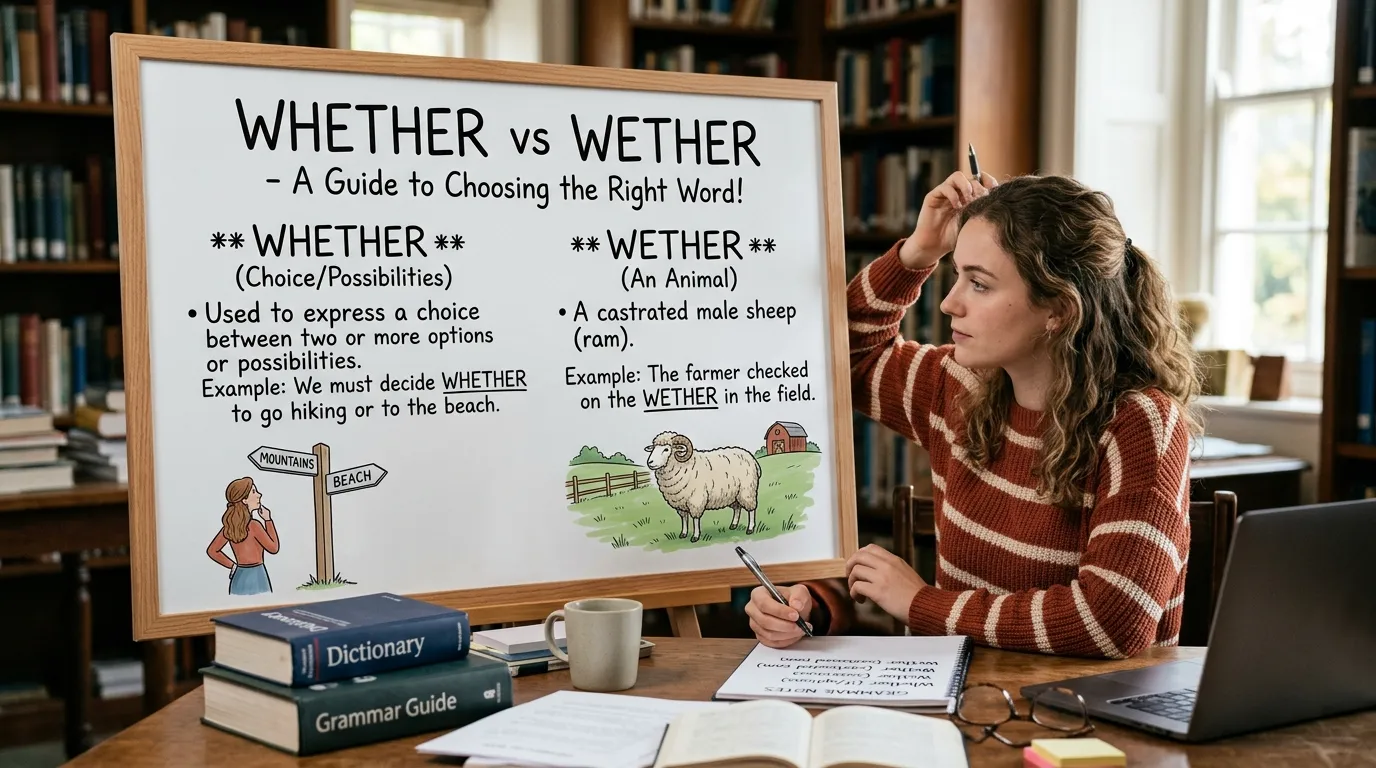
Have you ever wondered whether the correct spelling is whether or wether? You’re not alone. These two words look very similar, but they have completely different meanings. Many English learners accidentally use wether when they mean whether, making this a common spelling and vocabulary mistake.
The correct word in most everyday situations is whether. It is a conjunction used to introduce choices, alternatives, or uncertainty. You’ll often see it in sentences such as “I don’t know whether to go” or “Whether it rains or shines, we’ll be there.”
The word wether is also a real English word, but it has a very different meaning. A wether is a castrated male sheep, a term mainly used in farming and agriculture. Because it is rarely used outside those contexts, many people mistakenly think it is an alternative spelling of whether, but it is not.
In this guide, you’ll learn the difference between whether and wether, their meanings, pronunciation, grammar rules, examples, common mistakes, memory tricks, and frequently asked questions.
Quick Answer
| Word | Correct? | Meaning |
|---|---|---|
| ✅ Whether | Yes | Used to express a choice, condition, or uncertainty |
| ✅ Wether | Yes (rare) | A castrated male sheep |
For almost all everyday writing, you should use whether.
Examples
- I don’t know whether he will come.
- Please tell me whether you agree.
- The farmer sold a wether at the market.
What Does “Whether” Mean?
Whether is a conjunction.
It is used to introduce alternatives, choices, or uncertainty.
Examples
- I don’t know whether she is coming.
- Tell me whether you agree.
- Whether you win or lose, keep trying.
- We haven’t decided whether to travel.
What Does “Wether” Mean?
Wether is a noun.
It means a castrated male sheep, usually raised for wool or meat.
Examples
- The farmer kept several wethers.
- The wether grazed peacefully in the field.
- A wether is easier to manage than a ram.
Because this word is mainly used in agriculture, most English speakers rarely encounter it.
Grammar Role of Whether
Whether functions as a conjunction.
Common Expressions
- Whether or not
- Whether to
- Whether…or…
- Decide whether
- Ask whether
Examples
- I can’t decide whether to stay.
- Whether or not you agree is your choice.
Grammar Role of Wether
Wether functions as a noun.
Examples
- The wether was moved to another pasture.
- Farmers often separate the wether from the ram.
Whether vs Wether
| Feature | Whether | Wether |
|---|---|---|
| Correct spelling | ✅ Yes | ✅ Yes |
| Meaning | Choice or uncertainty | Castrated male sheep |
| Part of speech | Conjunction | Noun |
| Everyday use | Very common | Rare |
| American English | Yes | Yes |
| British English | Yes | Yes |
Pronunciation
Whether
UK IPA: /ˈweð.ə(r)/
US IPA: /ˈweð.ɚ/
Pronunciation:
WETH-er
Wether
UK IPA: /ˈweð.ə(r)/
US IPA: /ˈweð.ɚ/
Pronunciation:
WETH-er
Both words are pronounced the same, making them homophones.
Common Uses of “Whether”
Decisions
- Whether to stay
- Whether to leave
Questions
- Whether he agrees
- Whether it is true
Conditions
- Whether or not
- Whether you like it or not
Common Uses of “Wether”
Farming
- Male wether
- Sheep farming
- Wool production
Whether vs Similar Words
| Word | Meaning |
|---|---|
| Whether | Choice or uncertainty |
| If | Introduces a condition (sometimes interchangeable with whether) |
| Wether | Castrated male sheep |
| Weather | Atmospheric conditions |
Common Mistakes
Incorrect
❌ I don’t know wether to go.
Correct
✅ I don’t know whether to go.
Incorrect
❌ Tell me wether you agree.
Correct
✅ Tell me whether you agree.
Correct (Agriculture)
✅ The farmer bought a wether.
Incorrect
❌ Whether is a type of sheep.
Correct
✅ Wether is a type of sheep.
Real-Life Examples
Everyday English
- I don’t know whether it’s true.
- Whether we win or lose, we’ll learn something.
School
- The teacher asked whether we finished our homework.
- Students discussed whether the answer was correct.
Farming
- The farmer sold several wethers.
- The wether grazed in the field.
American English Example Sentences
Whether
- I don’t know whether to stay.
- Tell me whether you agree.
- Whether it rains or shines, we’ll go.
- She asked whether I was ready.
- We must decide whether to invest.
Wether
- The farmer raised a wether.
- The wether was healthy.
- The wether grazed quietly.
- They separated the wether from the ram.
- The wether was sold at auction.
British English Example Sentences
Whether
- I don’t know whether he’s coming.
- Whether or not you agree, we must continue.
- She wondered whether to apply.
- We discussed whether the plan would work.
- Please tell me whether you’re attending.
Wether
- The wether remained in the field.
- Farmers often keep a wether with the flock.
- The wether was easy to manage.
- The wether produced quality wool.
- The farmer inspected the wether.
Easy Memory Tricks
Whether = Choice
Think:
Whether = Which
Both begin with “Wh.”
Use whether when making a choice.
Wether = Sheep
Remember:
Wether is a farming word.
If you’re not talking about sheep, you almost certainly mean whether.
Frequently Asked Questions
Is whether or wether correct?
Both are correct, but they have different meanings.
- Whether = choice or uncertainty
- Wether = a castrated male sheep
Which word is used in everyday English?
Whether is used far more often.
Is wether a real word?
Yes. It refers to a castrated male sheep.
How do you spell whether?
W-H-E-T-H-E-R
Are whether and wether pronounced the same?
Yes. They are homophones.
Is the spelling different in British and American English?
No. Both varieties use the same spellings.
People Also Ask
Why do people confuse whether and wether?
Because they are pronounced exactly the same but have different meanings. Most people rarely see wether, so they accidentally use it instead of whether.
Is whether used in formal writing?
Yes. It is common in academic, business, legal, and everyday English.
What’s the easiest way to remember whether?
Think:
Whether = Choice
If you’re expressing uncertainty or choosing between options, use whether.
What’s the difference between whether and if?
Whether is used for choices or alternatives, while if is often used for conditions. In some contexts they are interchangeable, but whether is preferred when expressing alternatives or after prepositions.
Conclusion
If you’re deciding between whether and wether, remember that whether is the word used for choices, alternatives, and uncertainty, while wether is a castrated male sheep used in farming.
Although both words are correctly spelled English words and are pronounced the same, they have completely different meanings. In everyday writing, whether is almost always the word you need.


