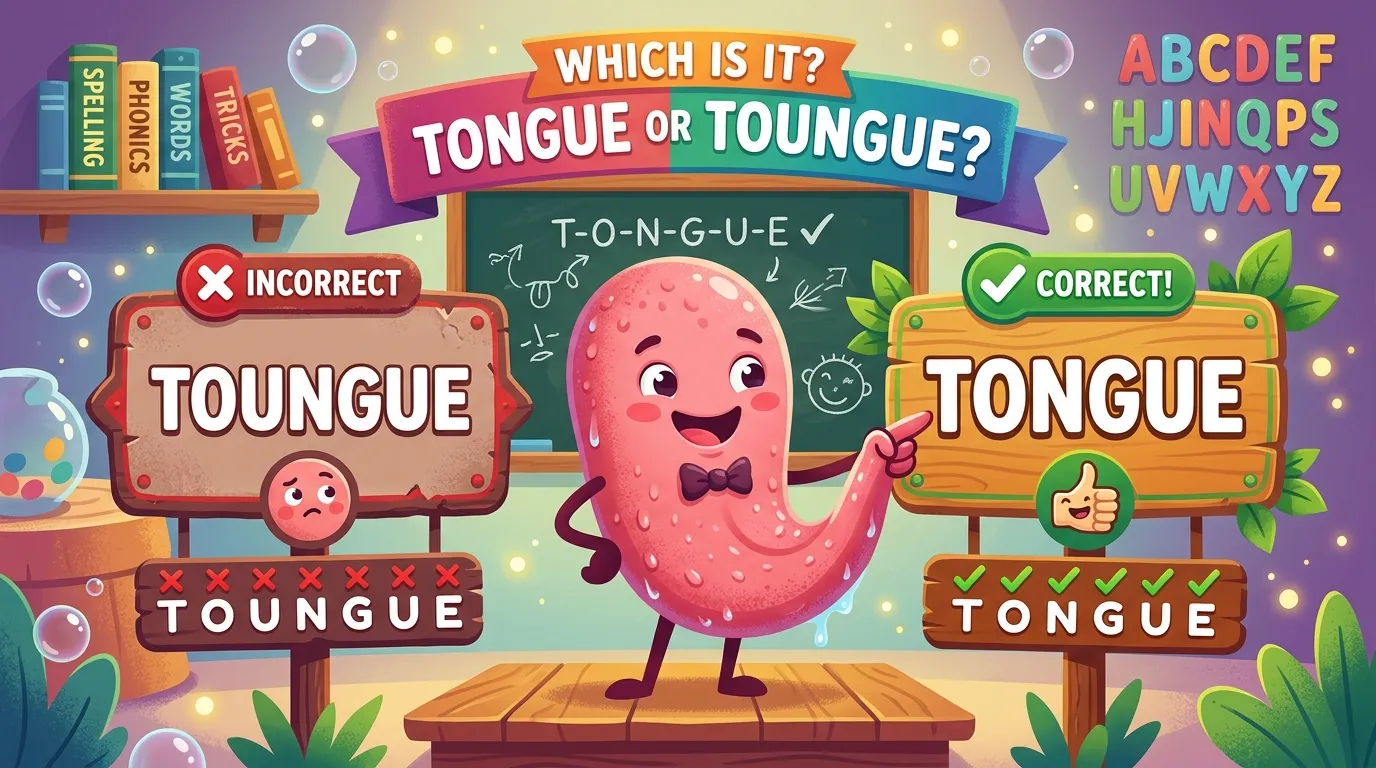
Have you ever wondered whether the correct spelling is tongue or toungue? You’re not alone. This is a common English spelling mistake because the pronunciation of the word does not clearly match its spelling. Many people accidentally rearrange the letters and write toungue, but only one spelling is correct in standard English.
The correct spelling is tongue. It is a noun that refers to the muscular organ inside the mouth used for speaking, tasting, and moving food. The word can also be used figuratively to refer to a language or a person’s way of speaking.
The spelling toungue is incorrect. It is a common misspelling caused by switching the positions of “u” and “n.” Standard English dictionaries recognize only tongue as the correct spelling.
In this guide, you’ll learn the correct spelling, meaning, pronunciation, grammar rules, US vs. UK usage, examples, common mistakes, memory tricks, and frequently asked questions about tongue or toungue.
Quick Answer
| Spelling | Correct? |
|---|---|
| ✅ Tongue | Correct |
| ❌ Toungue | Incorrect |
Tongue refers to the organ inside the mouth used for tasting, speaking, and moving food.
Examples
- She burned her tongue on the hot tea.
- He stuck out his tongue.
- English is his native tongue.
What Does “Tongue” Mean?
Tongue is primarily a noun.
It refers to the muscular organ inside the mouth.
Examples
- The tongue helps us taste food.
- He accidentally bit his tongue.
- She burned her tongue on the hot soup.
Tongue can also mean a language.
Example
- English is his native tongue.
It can also describe a person’s speech or manner of speaking.
Example
- She has a sharp tongue.
Why Is “Toungue” Incorrect?
The spelling toungue is incorrect because the letters are in the wrong order.
The correct spelling is:
T-O-N-G-U-E
Not:
❌ T-O-U-N-G-U-E
The correct word contains “tongue”, with the “n” before the “g.”
No standard English dictionary recognizes toungue as the correct spelling.
Grammar Role of Tongue
Tongue is mainly a noun.
Common Expressions
- Native tongue
- Mother tongue
- Tongue-tied
- Hold your tongue
- Bite your tongue
- Sharp tongue
- Slip of the tongue
Examples
- Spanish is her mother tongue.
- He was tongue-tied during the interview.
- I had to bite my tongue.
Tongue in American English
American English uses tongue.
Examples
- He burned his tongue.
- English is her native tongue.
- She has a sharp tongue.
- The child stuck out his tongue.
Tongue in British English
British English also uses tongue.
Examples
- She bit her tongue.
- English is his mother tongue.
- He was tongue-tied.
- The child stuck out his tongue.
There is no spelling difference between American and British English.
Tongue vs Toungue
| Feature | Tongue | Toungue |
|---|---|---|
| Correct spelling | ✅ Yes | ❌ No |
| Dictionary word | Yes | No |
| Meaning | Mouth organ or language | No meaning |
| Part of speech | Noun | Incorrect spelling |
| American English | Yes | No |
| British English | Yes | No |
Pronunciation
Tongue
UK IPA: /tʌŋ/
US IPA: /tʌŋ/
Pronunciation:
TUNG
The final “ue” is silent, which makes the spelling especially difficult.
Common Uses of “Tongue”
Anatomy
- The tongue helps with taste.
- He bit his tongue.
Language
- Native tongue
- Mother tongue
Speech
- Sharp tongue
- Tongue-tied
Idioms
- Bite your tongue
- Hold your tongue
- Slip of the tongue
Tongue vs Similar Words
| Word | Meaning |
|---|---|
| Tongue | Organ in the mouth or a language |
| Language | A system of communication |
| Speech | Spoken communication |
| Dialect | A variety of a language |
| Voice | Sound produced when speaking |
Common Mistakes
Incorrect
❌ I bit my toungue.
Correct
✅ I bit my tongue.
Incorrect
❌ English is my mother toungue.
Correct
✅ English is my mother tongue.
Incorrect
❌ She has a sharp toungue.
Correct
✅ She has a sharp tongue.
Incorrect
❌ He was toungue-tied.
Correct
✅ He was tongue-tied.
Real-Life Examples
Anatomy
- The tongue helps us taste food.
- She burned her tongue on the hot soup.
Language
- Urdu is his mother tongue.
- English is her native tongue.
Speech
- He has a sharp tongue.
- She was tongue-tied during the presentation.
Everyday Expressions
- I had to bite my tongue.
- He let the secret slip off his tongue.
American English Example Sentences
- She burned her tongue on the hot coffee.
- English is his native tongue.
- He accidentally bit his tongue.
- The child stuck out his tongue.
- She has a sharp tongue.
- He was tongue-tied during the interview.
- Spanish is her mother tongue.
- I had to bite my tongue.
- The tongue helps us taste food.
- He made a slip of the tongue.
British English Example Sentences
- She burned her tongue on the hot tea.
- English is his mother tongue.
- He accidentally bit his tongue.
- The child stuck out his tongue.
- She has a sharp tongue.
- He was tongue-tied during the interview.
- Urdu is her native tongue.
- I had to bite my tongue.
- The tongue helps us taste food.
- He made a slip of the tongue.
Easy Memory Tricks
Remember “Tongue” as “Tong”
Think of the spelling:
T-O-N-G-U-E
The N comes before the G.
Remember the Silent Ending
The word ends in:
GUE
But it is pronounced simply:
TUNG
Practice
Write it three times:
Tongue
Tongue
Tongue
Frequently Asked Questions
Is tongue or toungue correct?
Tongue is the correct spelling.
Is toungue a real word?
No. It is a common spelling mistake.
What does tongue mean?
It can mean the organ inside the mouth used for tasting and speaking, or a language.
Is tongue a noun?
Yes.
How do you spell tongue?
T-O-N-G-U-E
Is the spelling different in British and American English?
No. Both use tongue.
How do you pronounce tongue?
TUNG
People Also Ask
Why do people spell tongue as toungue?
Because the pronunciation does not clearly reveal the spelling, and people often accidentally switch the “n” and “u.” The correct spelling is tongue.
Is tongue used in formal writing?
Yes. It is commonly used in medical, linguistic, academic, literary, and everyday writing.
What’s the easiest way to remember tongue?
Remember the correct letter order:
T-O-N-G-U-E
The N comes before the G-U-E ending.
What’s the difference between tongue and language?
A tongue can refer to a language, especially in expressions such as mother tongue or native tongue. Language is the more common general term.
Conclusion
If you’re choosing between tongue and toungue, the correct spelling is tongue. Toungue is a common spelling mistake caused by switching the positions of the “n” and “u.”
Tongue is a noun that refers to the organ inside the mouth used for tasting, speaking, and moving food. It can also refer to a language, as in mother tongue or native tongue. The spelling is the same in both American and British English. A simple way to remember it is T-O-N-G-U-E: the N comes before the G-U-E ending.


