In today’s world of emails, text messages, business communication, and online learning, writing clearly matters more than ever. While acronyms like CEO, MBA, and FBI have become part of everyday communication, correct spelling is just as important. One small spelling mistake can make a message look unprofessional or confusing.
Many people search for “Sincerely or Sincerly” because they want to know which spelling is correct before sending an email, writing a cover letter, or ending a formal message. It is a common mistake because the words look very similar, but only one is accepted in standard English.
In this guide, you’ll learn the correct spelling of sincerely, its meaning, pronunciation, grammar rules, common mistakes, examples, and when to use it in formal and informal writing. You’ll also learn about acronyms, abbreviations, and initialisms, since these often appear alongside formal writing in modern communication.
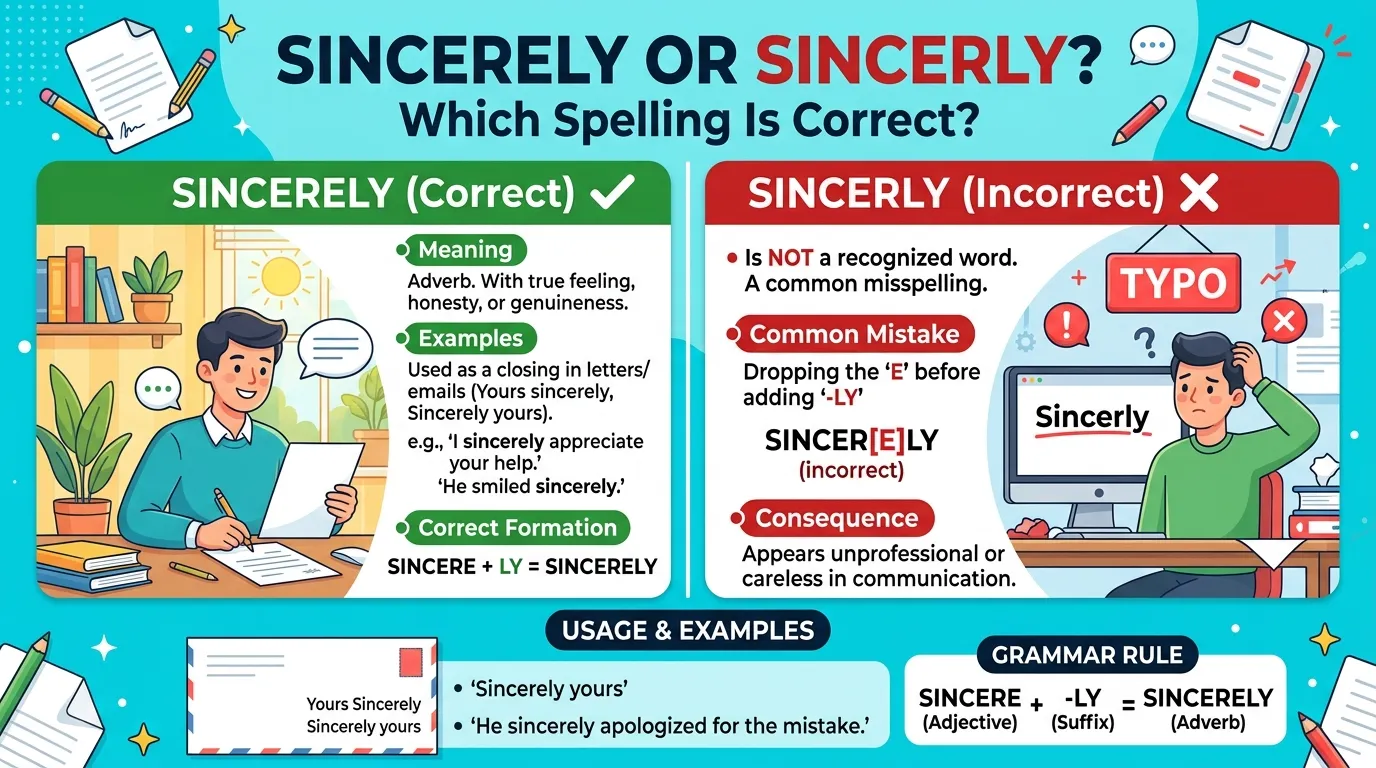
Sincerely or Sincerly: Which Is Correct?
✅ Correct: Sincerely
❌ Incorrect: Sincerly
The correct English spelling is sincerely.
The spelling sincerly is a common typo because many people accidentally leave out the second e after r.
Quick Comparison
| Word | Correct? | Meaning |
|---|---|---|
| Sincerely | ✅ Yes | In an honest, genuine, or truthful way; commonly used as an email or letter closing. |
| Sincerly | ❌ No | Incorrect spelling. |
What Does “Sincerely” Mean?
Sincerely is an adverb that means:
- Honestly
- Genuinely
- Truthfully
- With real feelings
It is also one of the most popular formal closings in letters and emails.
Examples
- I sincerely appreciate your help.
- She sincerely apologized for the mistake.
- Sincerely,
John Smith
Pronunciation
Sincerely
IPA (American English): /sɪnˈsɪr.li/
Pronounced as:
sin-SEER-lee
Why Do People Misspell “Sincerely”?
Several reasons make this word confusing.
Common causes include:
- Forgetting the second e
- Typing too quickly
- Depending too much on autocorrect
- Pronouncing the word without noticing every letter
- Confusing it with other words ending in -ly
Remember this simple pattern:
Sincere + ly = Sincerely
Origin of the Word
The word sincerely comes from:
- Latin: sincerus (clean, pure, genuine)
- French: sincère
- English: sincere + -ly
The ending -ly turns the adjective sincere into the adverb sincerely.
Acronyms, Abbreviations, and Initialisms Explained
Although sincerely is not an acronym, many people searching about professional writing also encounter abbreviations in emails and business communication.
Understanding the difference helps improve communication.
What Is an Acronym?
An acronym is formed from the first letters of several words and is pronounced like one word.
Examples:
- NASA
- UNICEF
- SCUBA
- RADAR
What Is an Abbreviation?
An abbreviation is any shortened version of a word or phrase.
Examples:
- Dr.
- Ave.
- Dept.
- Jan.
What Is an Initialism?
An initialism is made from the first letters of words, but each letter is pronounced separately.
Examples:
- FBI
- CEO
- MBA
- BBC
- ATM (often spoken letter by letter)
Acronym vs Abbreviation vs Initialism
| Type | Pronunciation | Example |
|---|---|---|
| Acronym | Read as one word | NASA |
| Initialism | Letters spoken individually | FBI |
| Abbreviation | Shortened word | Dr. |
A or An Before Acronyms
The choice between a and an depends on pronunciation, not spelling.
Use an before vowel sounds.
Examples:
- an MBA
- an FBI agent
- an HR manager
- an LCD screen
These begin with vowel sounds when spoken:
- MBA → em-bee-ay
- FBI → ef-bee-eye
Use a before consonant sounds.
Examples:
- a CEO
- a NASA engineer
- a USB drive
- a university
Although CEO begins with C, it is pronounced “see,” which starts with a consonant sound.
Common Mistakes
❌ a MBA
✅ an MBA
❌ an CEO
✅ a CEO
❌ a FBI officer
✅ an FBI officer
Always listen to the sound, not the first letter.
Quick Usage Table
| Word | Full Form | Meaning | Tone | Common Usage |
|---|---|---|---|---|
| Sincerely | Not an acronym | Honestly; formal closing | Formal | Emails, business letters |
| CEO | Chief Executive Officer | Company leader | Formal | Business |
| MBA | Master of Business Administration | Graduate degree | Formal | Education |
| FBI | Federal Bureau of Investigation | U.S. law enforcement | Formal | Government |
| ASAP | As Soon As Possible | Quickly | Neutral | Work, texting |
| FYI | For Your Information | Sharing information | Neutral | Email, chat |
| BTW | By The Way | Additional information | Casual | Texting |
| IMO | In My Opinion | Personal opinion | Casual | Social media |
How to Use “Sincerely”
In Business Emails
Example:
Thank you for your time.
Sincerely,
Sarah Johnson
In Cover Letters
Example:
I appreciate your consideration.
Sincerely,
David Brown
In Formal Letters
Example:
I look forward to your response.
Sincerely,
Emily Carter
Real-World Examples
Workplace
- I sincerely appreciate your feedback.
- Thank you for your support.
- Sincerely,
Michael
Academic Writing
- The author sincerely thanks the research team.
- We sincerely acknowledge the participants.
Customer Service
- We sincerely apologize for the inconvenience.
- We sincerely value your business.
Social Media
People rarely end social media posts with Sincerely, but they may write:
“I sincerely hope everyone stays safe.”
Texting
Friends usually avoid Sincerely because it sounds very formal.
Instead they say:
- Thanks!
- Take care!
- Best!
- See you!
When Should You Use “Sincerely”?
Use it when writing:
- Business emails
- Job applications
- Cover letters
- Official requests
- Professional thank-you letters
- Customer service responses
When Should You Avoid It?
Avoid using Sincerely in:
- Casual texting
- Family chats
- Gaming conversations
- Social media comments
- Friendly WhatsApp messages
Instead use:
- Thanks
- Best
- Cheers
- Take care
- Talk soon
Common Mistakes
1. Writing “Sincerly”
❌ Sincerly
✅ Sincerely
2. Using It in Casual Texts
Too formal:
“Sincerely,
Mike”
Better:
“Thanks!”
3. Mixing Formal and Casual Language
Example:
“LOL!
Sincerely,
David”
The tone feels inconsistent.
4. Overusing Acronyms
Poor:
FYI, ASAP, ETA, TBD, IMO…
Better:
Use acronyms only when your audience understands them.
5. Cultural Misunderstandings
Some abbreviations are common in one country but unfamiliar in another.
Always consider your audience.
Usage Guide
Professional Writing
Use:
- Sincerely
- Regards
- Kind regards
- Respectfully
Avoid texting abbreviations unless appropriate.
Academic Writing
Use formal language.
Limit unexplained acronyms.
Define the acronym the first time.
Example:
Master of Business Administration (MBA)
Later:
MBA
Corporate Communication
Common acceptable acronyms:
- CEO
- CFO
- KPI
- HR
- CRM
Digital Communication
Casual abbreviations include:
- LOL
- BRB
- BTW
- IMO
- TBH
Know your audience before using them.
Practice Exercises
Fill in the Blank
1.
The correct spelling is ________.
A. Sincerly
B. Sincerely
2.
Thank you for your support.
________,
James
Answer:
Sincerely
3.
She ________ apologized for the mistake.
Answer:
sincerely
Multiple Choice
Which spelling is correct?
A. Sincerly
B. Sincerely
✅ Answer: B
Which closing is most appropriate for a job application?
A. Bye
B. Later
C. Sincerely
D. LOL
Answer:
C
Which is an acronym?
A. NASA
B. FBI
C. Dr.
D. Mr.
Answer:
A
Rewrite the Sentence
Incorrect
Sincerly,
Amanda
Correct
Sincerely,
Amanda
Incorrect
I sincerly appreciate your help.
Correct
I sincerely appreciate your help.
Incorrect
an CEO
Correct
a CEO
Frequently Asked Questions
Is “Sincerly” a real word?
No. Sincerly is an incorrect spelling. Always use sincerely.
What does “Sincerely” mean?
It means honestly, genuinely, or truthfully. It is also a formal way to end letters and emails.
Is “Sincerely” formal?
Yes. It is one of the most common formal email and letter closings in English.
Can I use “Sincerely” in texting?
Usually no. It sounds too formal for everyday text messages between friends.
How do I remember the correct spelling?
Think of:
Sincere + ly = Sincerely
Do not remove the second e.
Is “Sincerely” an acronym?
No. It is a regular English adverb and a standard complimentary close in formal correspondence.
Should I use “a” or “an” before acronyms?
Choose a or an based on how the acronym sounds when spoken, not its first letter.
Examples:
- an MBA
- an FBI agent
- a CEO
- a NASA scientist
Conclusion
The correct spelling is sincerely, while sincerly is always incorrect. Whether you’re writing a business email, a cover letter, or a formal thank-you note, using the right spelling helps you appear professional and credible. At the same time, understanding the differences between acronyms, abbreviations, and initialisms can make your communication clearer across business, education, and digital platforms.
Remember that grammar rules—such as choosing a or an before an acronym—depend on pronunciation rather than spelling. By paying attention to spelling, tone, and context, you can write with greater confidence and communicate effectively in today’s modern world.


