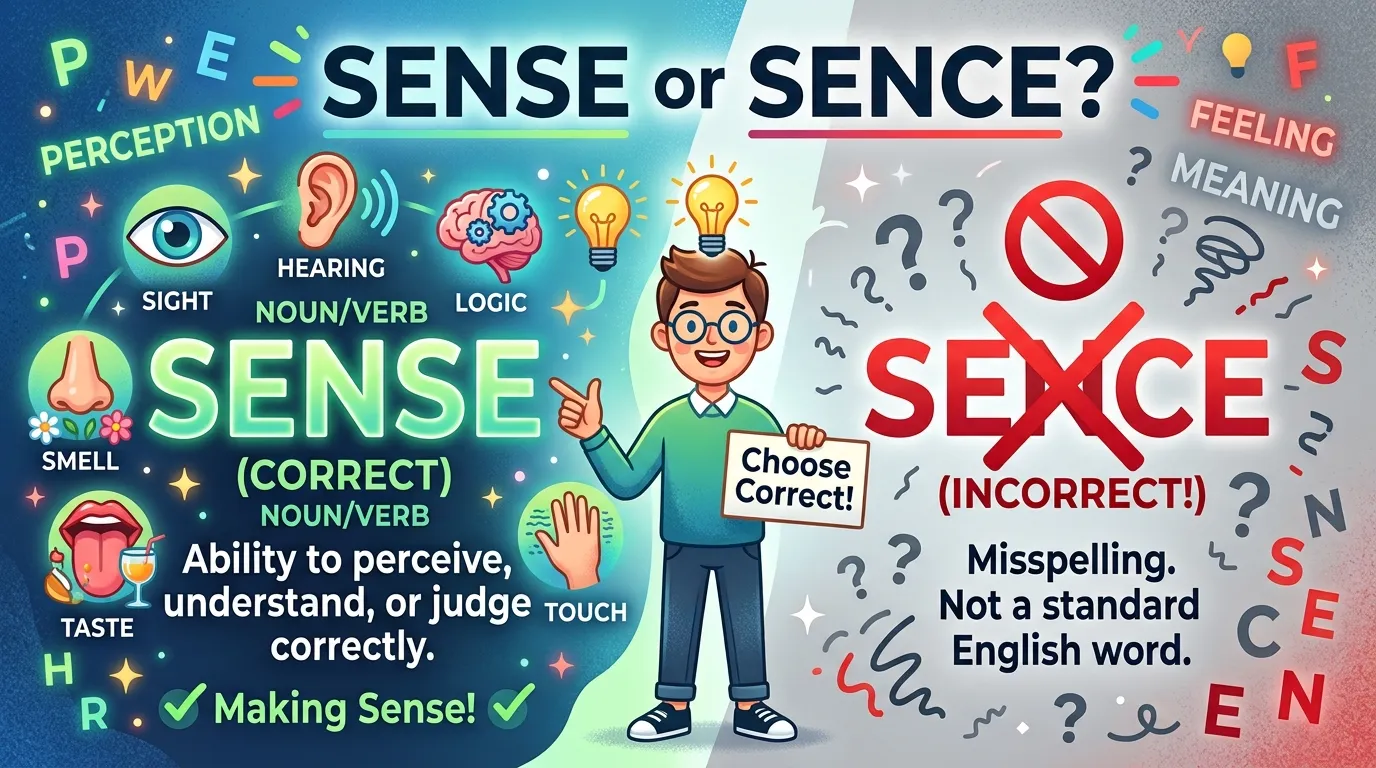
Many English learners, students, writers, and even native speakers wonder whether the correct spelling is sense or sence. Since these two spellings differ by just one letter, they are often confused in writing. However, only one spelling is correct in standard English. The correct spelling is sense, while sence is a common misspelling.
The word sense is widely used in education, science, psychology, philosophy, literature, business, and everyday conversations. It refers to the ability to understand, perceive, or recognize something, and it can also mean meaning, judgment, awareness, or one of the five physical senses. Whether you’re talking about common sense, a sense of humor, the sense of smell, or saying that makes sense, sense is always the correct spelling.
Many people mistakenly write sence because the pronunciation of “s” and “c” sounds can be confusing in English. Learning the correct spelling, pronunciation, grammar, examples, etymology, and memory tricks will help you avoid this common spelling mistake.
The spelling sense is the same in both American English and British English, so there are no regional spelling differences to remember.
Quick Answer
| Word | Correct? |
|---|---|
| ✅ Sense | Correct |
| ❌ Sence | Incorrect |
Sense means understanding, meaning, judgment, awareness, or one of the body’s abilities to perceive the world.
Examples
- That explanation makes sense.
- She has a great sense of humor.
Sence is not a correct English spelling.
What Does Sense Mean?
Sense can function as both a noun and a verb.
As a noun, it refers to understanding, meaning, judgment, or one of the five senses.
As a verb, it means to detect or become aware of something.
Examples
- He has a strong sense of responsibility.
- The dog can sense danger.
- That sentence makes perfect sense.
- Our sense of taste helps us enjoy food.
Grammar Role of Sense
Sense functions as:
- Noun – understanding, meaning, awareness, or one of the five senses.
- Verb – to notice, detect, or feel something.
Common Expressions
- Common sense
- Sense of humor
- Sense of direction
- Sense of smell
- Sense of taste
- Make sense
- Sense of responsibility
- Sixth sense
Examples
- She has excellent common sense.
- I can sense a problem.
Sense in American English
American English always uses sense.
Examples
- That makes sense.
- He has a good sense of humor.
- I sensed something was wrong.
- She has a strong sense of direction.
- Common sense is important.
Sense in British English
British English also uses sense.
Examples
- The explanation makes sense.
- She has a wonderful sense of humour.
- I sensed a change in the weather.
- Common sense solved the problem.
- His sense of duty is admirable.
There is no spelling difference between UK and US English.
Sense vs Sence Comparison Table
| Feature | Sense | Sence |
|---|---|---|
| Correct spelling | ✅ Yes | ❌ No |
| Dictionary word | Yes | No |
| Meaning | Understanding or awareness | No meaning |
| Grammar | Noun and verb | Incorrect spelling |
| American English | Correct | Incorrect |
| British English | Correct | Incorrect |
| Professional writing | Recommended | Never use |
Pronunciation Guide
Sense
IPA (UK): /sens/
IPA (US): /sens/
Pronounced:
SENS
The pronunciation is simple, but remember that the correct spelling ends with -se, not -ce.
Why Do People Confuse Sense and Sence?
People often write sence because:
- The endings -se and -ce sound the same.
- English spelling rules can be confusing.
- Many words ending in -ce are common.
- Fast typing leads to spelling mistakes.
Remember:
Sense always ends with “se.”
Word Origin and Etymology
The word sense comes from the Latin word sensus, meaning feeling, perception, or understanding. It entered English through Old French and has been used for centuries to describe awareness, meaning, and perception.
Sense Synonyms
| Synonym | Meaning |
|---|---|
| Meaning | What something expresses |
| Understanding | Knowledge or comprehension |
| Awareness | Consciousness |
| Judgment | Good decision-making |
| Perception | Ability to notice |
| Reason | Logical thinking |
American English Preferences
- Sense
- Understanding
- Awareness
British English Preferences
- Sense
- Judgement
- Perception
Sense vs Related Words
| Word | Meaning |
|---|---|
| Sense | Understanding or perception |
| Meaning | Definition or significance |
| Awareness | Consciousness |
| Judgment | Decision-making ability |
| Perception | Recognition through the senses |
Examples
- That makes sense.
- What is the meaning of this word?
- Environmental awareness is increasing.
- She showed good judgment.
Grammar Rule Behind Sense
Always spell the word:
S-E-N-S-E
Notice:
- It ends with -se.
- Never replace “s” with “c.”
Do not write sence.
Common Mistakes and Corrections
1. Writing Sence
❌ That makes sence.
✅ That makes sense.
2. Wrong Ending
❌ Sence
✅ Sense
3. Incorrect Email
❌ Your explanation makes perfect sence.
✅ Your explanation makes perfect sense.
4. School Assignment Error
❌ Use your common sence.
✅ Use your common sense.
5. Business Communication Mistake
❌ This proposal makes good sence.
✅ This proposal makes good sense.
6. Resume Error
❌ Strong sence of responsibility.
✅ Strong sense of responsibility.
7. Social Media Mistake
❌ Finally, everything makes sence!
✅ Finally, everything makes sense!
Real-Life Examples
Emails
- Your explanation makes perfect sense.
- Please provide more details so the report makes sense.
Office
- She has excellent business sense.
- The manager showed good judgment and common sense.
School
- Students should use common sense.
- The lesson made sense after the explanation.
Healthcare
- The doctor tested the patient’s sense of smell.
- Loss of taste affects the sense of flavor.
Everyday Conversation
- That doesn’t make sense.
- He has a great sense of humor.
American English Example Sentences
- That makes sense.
- She has common sense.
- I sensed danger immediately.
- His sense of humor is amazing.
- The explanation makes perfect sense.
- Dogs have a strong sense of smell.
- I can sense excitement.
- She has a good sense of direction.
- Use your common sense.
- The decision made sense.
British English Example Sentences
- That explanation makes sense.
- She has a brilliant sense of humour.
- Common sense solved the issue.
- I sensed a problem.
- His sense of responsibility impressed everyone.
- The poem makes emotional sense.
- She has an excellent sense of direction.
- The decision made sense.
- We rely on our sense of hearing.
- The explanation made perfect sense.
Memory Tricks to Remember Sense
1. Remember the Common Phrase
Think:
“Makes sense.”
You’ll see this expression every day.
2. Remember the Ending
Sense always ends with:
SE
Never CE.
3. Associate It with Common Sense
The phrase common sense is one of the most frequently used expressions in English.
4. Break It Into Parts
Sen • se
Notice the ending “se.”
5. Write It Three Times
Sense
Sense
Sense
Frequently Asked Questions
Is sense or sence correct?
Sense is correct.
What does sense mean?
It means understanding, meaning, awareness, judgment, or one of the body’s abilities to perceive the world.
Is sence a word?
No.
How do you spell sense?
S-E-N-S-E
Is sense used in British English?
Yes.
Is sense used in American English?
Yes.
How do you pronounce sense?
SENS
Is sense a noun or a verb?
It can be both a noun and a verb.
What are synonyms of sense?
Meaning, understanding, awareness, judgment, perception, and reason.
Why is sence incorrect?
Because the correct spelling ends with -se, making it sense, not sence.
People Also Ask
Why do people spell sense as sence?
Because the endings -se and -ce sound the same in pronunciation, making them easy to confuse.
Is sense spelled differently in the UK and the US?
No. Both American English and British English use sense.
What is the easiest way to remember sense?
Think of the common phrase “That makes sense.” Since you’ve probably seen this expression many times, it helps reinforce the correct spelling.
Is sense formal or informal?
It is suitable for both formal and informal English and is widely used in education, science, business, healthcare, literature, and everyday communication.
Conclusion
Understanding the difference between sense or sence is simple once you know the correct spelling. Sense is the only accepted spelling in standard English, while sence is a common misspelling caused by confusion between the endings -se and -ce.
The word sense refers to understanding, meaning, perception, judgment, or one of the body’s natural abilities to detect the world around us. It is commonly used in expressions such as common sense, sense of humor, and that makes sense. Since American English and British English use the same spelling, there is only one correct form to remember.
A simple memory trick is “That makes sense.” Because this phrase appears so often in everyday English, remembering it will help you spell sense correctly every time and avoid a common English spelling mistake.


