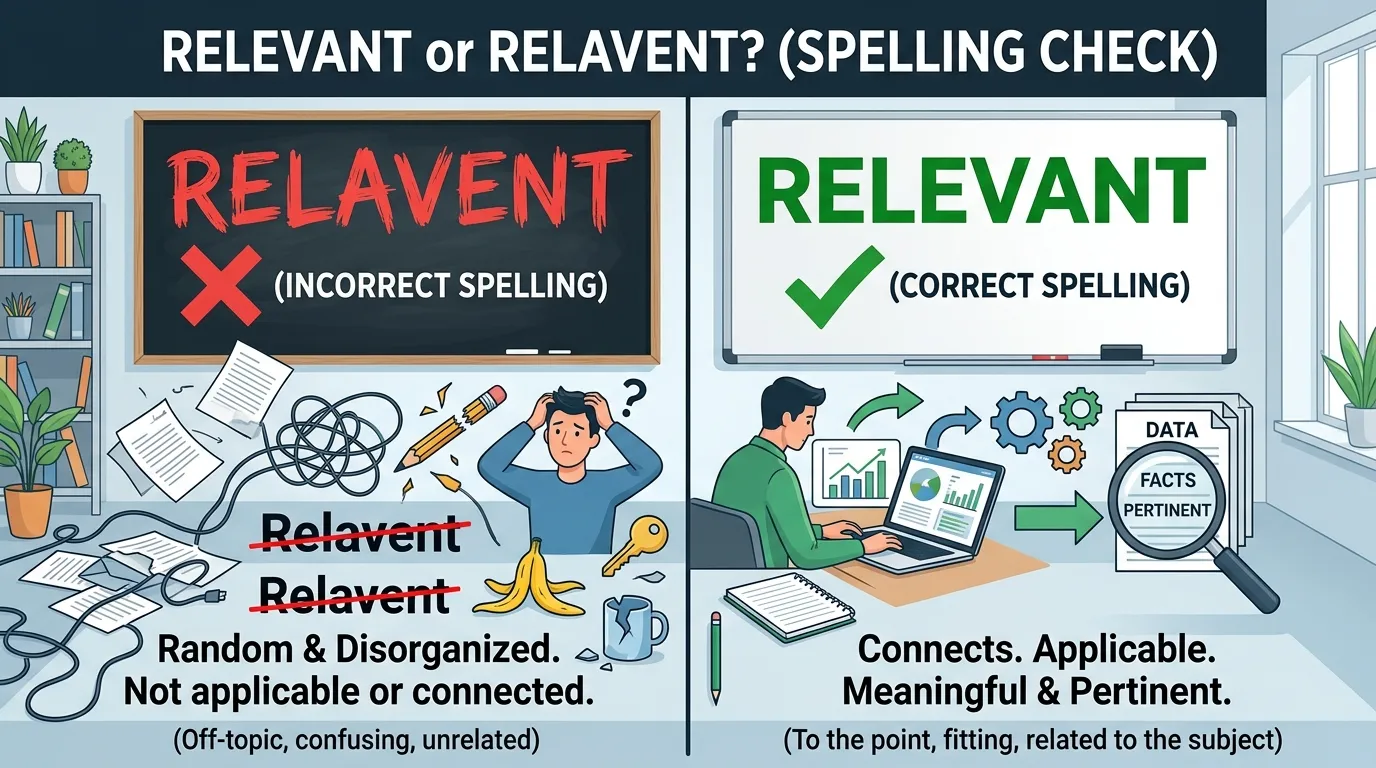
Have you ever wondered whether the correct spelling is relevant or relavent? You’re not alone. This is a common English spelling mistake because the vowel sounds in the middle of the word can be confusing. Many people accidentally write relavent, but only one spelling is correct in standard English.
The correct spelling is relevant. It is an adjective that means closely connected to a particular topic, situation, or subject. The word is widely used in academic writing, business communication, research, news, and everyday conversations.
The spelling relavent is incorrect. It is a common misspelling caused by changing the “e” in relevant to an “a.” Standard dictionaries in both American and British English recognize only relevant as the correct spelling.
In this guide, you’ll learn the correct spelling, meaning, pronunciation, grammar rules, US vs. UK usage, examples, common mistakes, memory tricks, and frequently asked questions about relevant or relavent.
Quick Answer
| Spelling | Correct? |
|---|---|
| ✅ Relevant | Correct |
| ❌ Relavent | Incorrect |
Relevant means related or closely connected to a particular subject or situation.
Examples
- Please provide relevant information.
- This example is relevant to the discussion.
- The evidence is highly relevant to the case.
What Does “Relevant” Mean?
Relevant is an adjective.
It describes something connected to or important for a particular topic, situation, or purpose.
Examples
- The information is relevant.
- She provided relevant evidence.
- This experience is relevant to the job.
- The question is relevant to our discussion.
Why Is “Relavent” Incorrect?
The spelling relavent is incorrect because the correct word contains “e” after the “l”:
Relevant
The incorrect spelling changes this “e” to an “a.”
No standard English dictionary recognizes relavent.
Grammar Role of Relevant
Relevant functions as an adjective.
It describes information, facts, experience, questions, evidence, or ideas that connect to a particular subject.
Common Expressions
- Relevant information
- Relevant experience
- Relevant details
- Relevant evidence
- Relevant facts
- Relevant experience
- Highly relevant
- Directly relevant
- Relevant to
Examples
- Please include relevant experience on your résumé.
- The evidence is relevant to the case.
Relevant in American English
American English always uses relevant.
Examples
- This information is relevant to the project.
- She has relevant work experience.
- Please provide relevant details.
- The evidence is highly relevant.
- That question is not relevant to the topic.
Relevant in British English
British English also uses relevant.
Examples
- The information is relevant to the discussion.
- He has relevant experience.
- Please include all relevant details.
- The evidence is directly relevant.
- This issue is highly relevant.
There is no spelling difference between American and British English.
Relevant vs Relavent
| Feature | Relevant | Relavent |
|---|---|---|
| Correct spelling | ✅ Yes | ❌ No |
| Dictionary word | Yes | No |
| Meaning | Related or connected | No meaning |
| Part of speech | Adjective | Incorrect spelling |
| American English | Yes | No |
| British English | Yes | No |
Pronunciation
Relevant
UK IPA: /ˈrel.ə.vənt/
US IPA: /ˈrel.ə.vənt/
Pronunciation:
REL-uh-vuhnt
Remember that the correct spelling is relevant, not relavent.
Common Uses of “Relevant”
Education
- Relevant information
- Relevant examples
Business
- Relevant experience
- Relevant skills
Research
- Relevant evidence
- Relevant data
Everyday Life
- Relevant details
- Relevant questions
Relevant vs Similar Words
| Word | Meaning |
|---|---|
| Relevant | Connected to the subject |
| Related | Connected in some way |
| Applicable | Suitable for a particular situation |
| Pertinent | Directly related and important |
| Appropriate | Suitable or fitting |
Examples
- This information is relevant.
- The topic is related to our discussion.
- The rule is applicable to everyone.
Common Mistakes
Incorrect
❌ This information is relavent.
Correct
✅ This information is relevant.
Incorrect
❌ She has relavent experience.
Correct
✅ She has relevant experience.
Incorrect
❌ Please provide relavent details.
Correct
✅ Please provide relevant details.
Incorrect
❌ The evidence is relavent to the case.
Correct
✅ The evidence is relevant to the case.
Real-Life Examples
School
- Students should include relevant information in their essays.
- The teacher gave a relevant example.
Workplace
- Employers look for relevant experience.
- Please provide relevant skills.
Research
- Researchers reviewed relevant studies.
- The report included relevant data.
Everyday Conversations
- That comment is not relevant.
- Please stay relevant to the topic.
American English Example Sentences
- Please provide relevant information.
- She has relevant work experience.
- This evidence is relevant to the case.
- The question is relevant to the discussion.
- The report contains relevant data.
- He shared several relevant details.
- This skill is highly relevant to the job.
- The information is directly relevant.
- That example is not relevant.
- The article discusses relevant issues.
British English Example Sentences
- Please include relevant information.
- She has relevant experience.
- The evidence is relevant to the case.
- This point is relevant to the discussion.
- The report contains relevant details.
- He provided relevant documents.
- The issue is highly relevant.
- This example is directly relevant.
- The information is not relevant.
- The article covers relevant topics.
Easy Memory Tricks
Remember the Correct Vowel
The correct spelling is:
Relevant
It contains:
REL-E-VANT
Not:
❌ REL-A-VANT
Think of “Relate”
The word relevant is connected to the idea of being related.
Relevant = Related
This can help you remember the correct spelling.
Practice
Write it three times:
Relevant
Relevant
Relevant
Frequently Asked Questions
Is relevant or relavent correct?
Relevant is the correct spelling.
Is relavent a real word?
No. It is a common spelling mistake.
What does relevant mean?
It means related or closely connected to a particular topic or situation.
Is relevant an adjective?
Yes.
How do you spell relevant?
R-E-L-E-V-A-N-T
Is the spelling different in British and American English?
No. Both use relevant.
How do you pronounce relevant?
REL-uh-vuhnt
People Also Ask
Why do people spell relevant as relavent?
Because the vowel sounds in the word can be confusing, many people accidentally replace the correct “e” with an “a.” The correct spelling is relevant.
Is relevant used in formal writing?
Yes. It is widely used in academic writing, business communication, research, legal documents, and everyday English.
What’s the easiest way to remember relevant?
Connect relevant with the word related. Both words describe something connected to a particular subject or topic.
What’s the difference between relevant and related?
Relevant means directly connected and important to a particular subject or situation. Related has a broader meaning and simply means connected in some way.
Conclusion
If you’re choosing between relevant and relavent, the correct spelling is relevant. Relavent is a common spelling mistake caused by changing the “e” in the correct word to an “a.”
Relevant is an adjective that means related, connected, or important to a particular subject or situation. It is the standard spelling in both American and British English and is commonly used in education, business, research, and everyday communication. A simple way to remember it is to connect relevant with related, helping you remember the correct “e” spelling every time.


