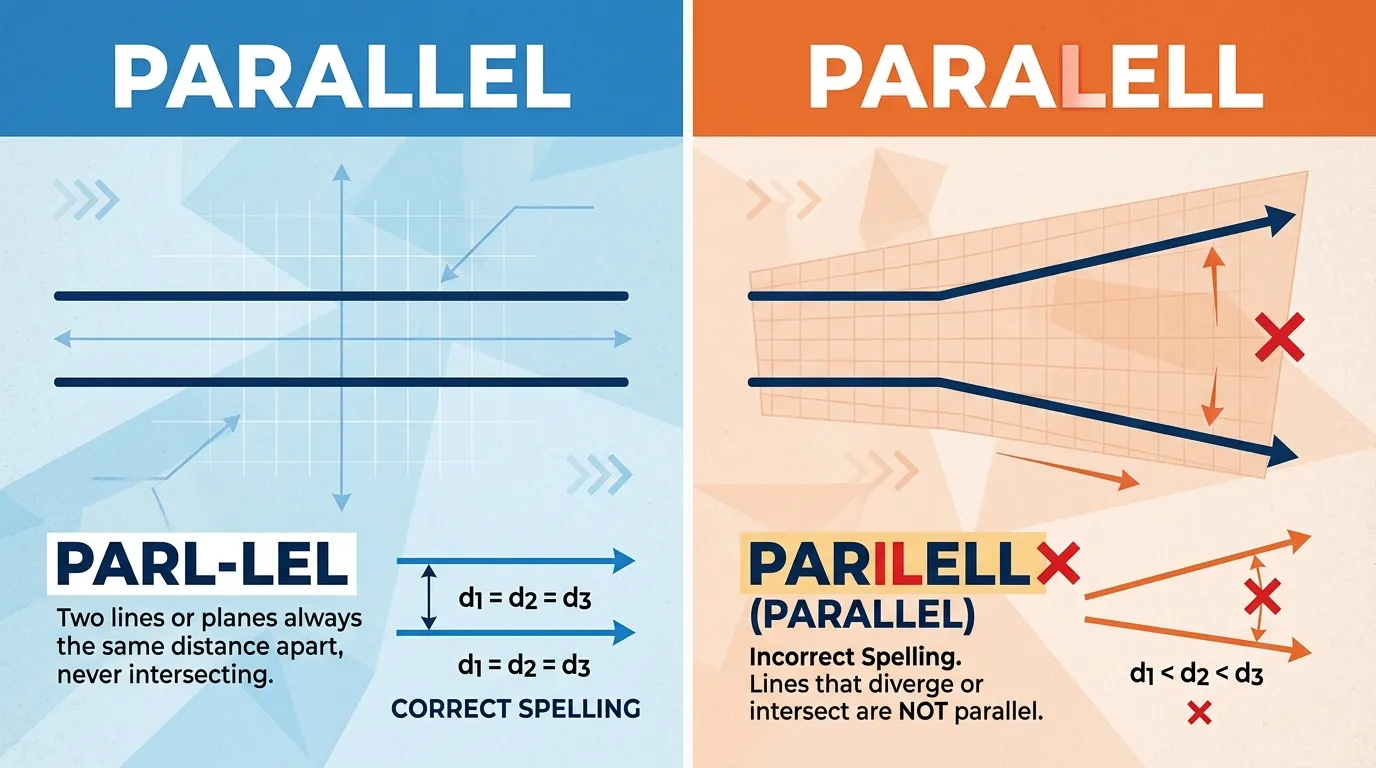
Many English learners, students, writers, and even native speakers wonder whether the correct spelling is parallel or paralell. Since both spellings look very similar, they are often confused in writing. However, only one spelling is correct in standard English. The correct spelling is parallel, while paralell is a common misspelling.
The word parallel is widely used in mathematics, geometry, science, engineering, technology, literature, and everyday conversations. It can function as both an adjective and a noun, and sometimes as a verb. As an adjective, it describes two or more lines, objects, or situations that run in the same direction without meeting. It can also describe things that are similar or comparable. Whether you’re discussing parallel lines, parallel processing, parallel universes, or parallel experiences, parallel is always the correct spelling.
Many people mistakenly write paralell because they confuse the placement of the letters “a” and “e” or forget that the correct word contains two “l” letters at the end and only one “e” before them. Learning the correct spelling, pronunciation, grammar, examples, etymology, and memory tricks will help you avoid this common spelling mistake.
The spelling parallel is the same in both American English and British English, so there are no regional spelling differences to remember.
Quick Answer
| Word | Correct? |
|---|---|
| ✅ Parallel | Correct |
| ❌ Paralell | Incorrect |
Parallel means running side by side without meeting or being very similar or comparable.
Examples
- The two roads run parallel to each other.
- Their experiences were surprisingly parallel.
Paralell is not a correct English spelling.
What Does Parallel Mean?
Parallel can be a noun, adjective, or verb.
It refers to:
- Lines or objects that never meet.
- Similar situations or events.
- Comparable characteristics.
- Something that corresponds closely to another.
Examples
- The railway tracks are parallel.
- There is a parallel between the two stories.
- Our careers followed parallel paths.
- The engineer designed parallel circuits.
Grammar Role of Parallel
Parallel functions as:
- Adjective – describing things that are side by side or similar.
- Noun – referring to a similarity or comparison.
- Verb – meaning to correspond or be similar to.
Common Expressions
- Parallel lines
- Parallel universe
- Parallel processing
- Parallel parking
- Parallel structure
- Parallel path
- Draw a parallel
- Parallel development
Examples
- The roads remain parallel.
- She drew a parallel between the two events.
Parallel in American English
American English always uses parallel.
Examples
- The lines are parallel.
- The two projects ran in parallel.
- Computers use parallel processing.
- Their experiences were parallel.
- The roads remained parallel for miles.
Parallel in British English
British English also uses parallel.
Examples
- The railway lines run parallel.
- The teacher explained parallel lines.
- There is a clear parallel between the novels.
- Their careers developed in parallel.
- Engineers use parallel circuits.
There is no spelling difference between UK and US English.
Parallel vs Paralell Comparison Table
| Feature | Parallel | Paralell |
|---|---|---|
| Correct spelling | ✅ Yes | ❌ No |
| Dictionary word | Yes | No |
| Meaning | Side by side or similar | No meaning |
| Grammar | Noun, adjective, verb | Incorrect spelling |
| American English | Correct | Incorrect |
| British English | Correct | Incorrect |
| Professional writing | Recommended | Never use |
Pronunciation Guide
Parallel
IPA (UK): /ˈpær.ə.lel/
IPA (US): /ˈper.ə.lel/
Pronounced:
PAR-uh-lel
Although the pronunciation may seem simple, remember that the word contains two “l” letters at the end.
Why Do People Confuse Parallel and Paralell?
People often write paralell because:
- They accidentally switch the positions of “a” and “e.”
- They are unsure where the double “l” belongs.
- Long words are easier to misspell.
- Fast typing causes spelling mistakes.
Remember:
Parallel = Para + llel
The correct spelling ends with -llel.
Word Origin and Etymology
The word parallel comes from the Greek word parallēlos, meaning running beside one another. It entered English through Latin and French and has long been used in mathematics, science, and literature to describe things that are side by side or closely comparable.
Parallel Synonyms
| Synonym | Meaning |
|---|---|
| Similar | Nearly the same |
| Comparable | Able to be compared |
| Corresponding | Matching |
| Equivalent | Equal in value or meaning |
| Aligned | Positioned in line |
| Matching | Closely resembling |
American English Preferences
- Parallel
- Similar
- Comparable
British English Preferences
- Parallel
- Corresponding
- Comparable
Parallel vs Related Words
| Word | Meaning |
|---|---|
| Parallel | Side by side or similar |
| Similar | Almost the same |
| Comparable | Suitable for comparison |
| Equal | Exactly the same |
| Corresponding | Matching another |
Examples
- The roads are parallel.
- The two reports are similar.
- Their achievements are comparable.
- The values are equal.
Grammar Rule Behind Parallel
Always spell the word:
P-A-R-A-L-L-E-L
Notice:
- Two “l” letters together.
- The ending is -lel, not -lall or -lell.
Do not write paralell.
Common Mistakes and Corrections
1. Writing Paralell
❌ The roads are paralell.
✅ The roads are parallel.
2. Switching Letters
❌ Paralell
✅ Parallel
3. Incorrect Email
❌ The projects ran paralell.
✅ The projects ran parallel.
4. School Assignment Error
❌ Draw two paralell lines.
✅ Draw two parallel lines.
5. Business Communication Mistake
❌ Our teams worked in paralell.
✅ Our teams worked in parallel.
6. Resume Error
❌ Managed paralell projects.
✅ Managed parallel projects.
7. Social Media Mistake
❌ Our lives seem paralell.
✅ Our lives seem parallel.
Real-Life Examples
Emails
- The projects will run in parallel.
- Our development teams are working on parallel tasks.
Office
- We managed several parallel projects.
- The company follows parallel workflows.
School
- Students learned about parallel lines.
- The teacher compared two parallel stories.
Technology
- Modern computers use parallel processing.
- Engineers designed parallel circuits.
Mathematics
- Parallel lines never intersect.
- The graph contains two parallel segments.
Everyday Conversation
- Our careers followed parallel paths.
- The two situations are surprisingly parallel.
American English Example Sentences
- The roads run parallel.
- The computers process data in parallel.
- Their stories are parallel.
- We managed parallel projects.
- The tracks remained parallel.
- Draw two parallel lines.
- The ideas are parallel.
- Engineers designed parallel circuits.
- Their experiences were parallel.
- Parallel parking requires practice.
British English Example Sentences
- The railway tracks are parallel.
- The teacher explained parallel lines.
- The stories have parallel themes.
- Engineers use parallel systems.
- Their careers developed in parallel.
- The roads remain parallel throughout the journey.
- The novel draws parallel narratives.
- We studied parallel structures in grammar.
- Parallel processing improves efficiency.
- The two events followed parallel patterns.
Memory Tricks to Remember Parallel
1. Remember the Double “L”
Think:
Parallel = LL
Never remove one of the “l” letters.
2. Think of Parallel Lines
Picture two straight lines side by side.
That image can help you remember the correct spelling.
3. Remember the Ending
The word ends with:
-llel
4. Break It Into Parts
Par • al • lel
5. Write It Three Times
Parallel
Parallel
Parallel
Frequently Asked Questions
Is parallel or paralell correct?
Parallel is correct.
What does parallel mean?
It means running side by side without meeting or being very similar.
Is paralell a word?
No.
How do you spell parallel?
P-A-R-A-L-L-E-L
Is parallel used in British English?
Yes.
Is parallel used in American English?
Yes.
How do you pronounce parallel?
PAR-uh-lel
Is parallel a noun or an adjective?
It can be a noun, adjective, or verb, depending on the sentence.
What are synonyms of parallel?
Similar, comparable, corresponding, equivalent, aligned, and matching.
Why is paralell incorrect?
Because the correct spelling is parallel, with the letters in the proper order and two consecutive “l” letters.
People Also Ask
Why do people spell parallel as paralell?
Because they accidentally switch the positions of the letters or forget the correct placement of the double “l.”
Is parallel spelled differently in the UK and the US?
No. Both American English and British English use parallel.
What is the easiest way to remember parallel?
Think of parallel lines—two lines running side by side. Also remember that parallel contains two consecutive “l” letters.
Is parallel formal or informal?
It is suitable for both formal and informal English and is widely used in mathematics, science, technology, engineering, education, literature, and everyday communication.
Conclusion
Understanding the difference between parallel or paralell is simple once you know the correct spelling. Parallel is the only accepted spelling in standard English, while paralell is a common misspelling caused by confusing the order of the letters and the placement of the double “l.”
The word parallel is commonly used to describe things that run side by side without meeting or situations that are similar or comparable. It is widely used in mathematics, science, engineering, technology, literature, and everyday conversation. Since American English and British English use the same spelling, there is only one correct form to remember.
A simple memory trick is “Parallel has two ‘L’ letters running side by side—just like parallel lines.” By remembering this visual cue and practicing the correct spelling, you’ll avoid a common English spelling mistake and write with greater confidence and accuracy.


