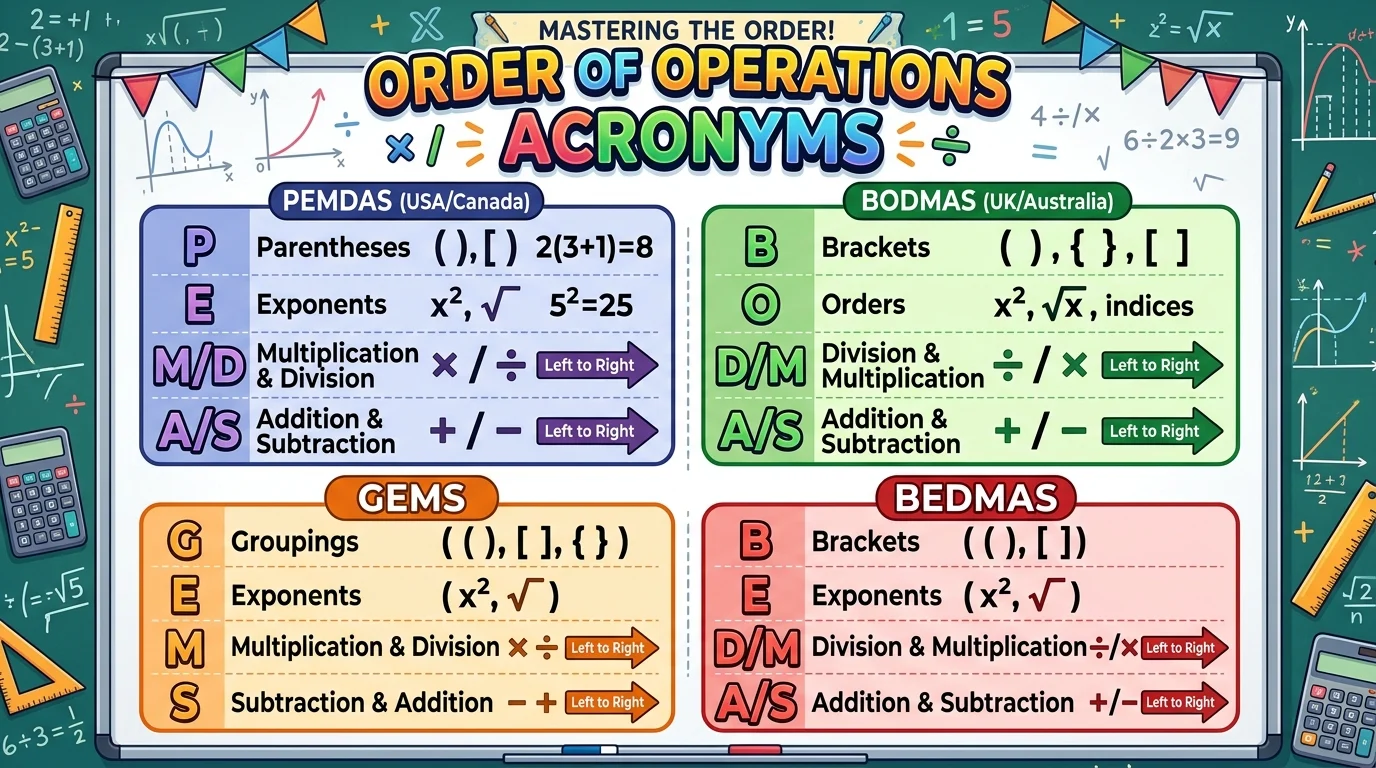
Order of operations acronyms are memory aids used in mathematics to help students solve equations correctly. These acronyms remind us of the sequence in which mathematical operations should be performed to ensure consistent and accurate answers.
Without following the correct order of operations, the same problem could produce different results.
What Is the Order of Operations?
The order of operations is a set of rules that tells us which mathematical operations to perform first when solving an expression.
For example:
8+2×3
Using the correct order of operations:
- Multiply first: 2 × 3 = 6
- Add: 8 + 6 = 14
Answer: 14
PEMDAS Acronym
The most common order of operations acronym is PEMDAS.
| Letter | Meaning |
|---|---|
| P | Parentheses |
| E | Exponents |
| M | Multiplication |
| D | Division |
| A | Addition |
| S | Subtraction |
PEMDAS Rule
Perform operations in this order:
- Parentheses
- Exponents
- Multiplication and Division (left to right)
- Addition and Subtraction (left to right)
Example Using PEMDAS
(5+3)2−4
Step 1: Parentheses → 5 + 3 = 8
Step 2: Exponents → 8² = 64
Step 3: Subtraction → 64 − 4 = 60
Answer: 60
BODMAS Acronym
Many countries use BODMAS instead of PEMDAS.
| Letter | Meaning |
|---|---|
| B | Brackets |
| O | Orders (Exponents) |
| D | Division |
| M | Multiplication |
| A | Addition |
| S | Subtraction |
BODMAS follows the same mathematical principles as PEMDAS.
BIDMAS Acronym
Another common variation is BIDMAS.
| Letter | Meaning |
|---|---|
| B | Brackets |
| I | Indices |
| D | Division |
| M | Multiplication |
| A | Addition |
| S | Subtraction |
“Indices” is another term for exponents.
BEDMAS Acronym
In some regions, students learn BEDMAS.
| Letter | Meaning |
|---|---|
| B | Brackets |
| E | Exponents |
| D | Division |
| M | Multiplication |
| A | Addition |
| S | Subtraction |
Again, the underlying mathematical rule remains the same.
Important Rule: Multiplication and Division
Many students mistakenly think multiplication always comes before division.
Actually:
- Multiplication and division have equal priority.
- Solve from left to right.
Example:
24÷6×2
24 ÷ 6 = 4
4 × 2 = 8
Answer: 8
Important Rule: Addition and Subtraction
Addition and subtraction also have equal priority.
Solve from left to right.
Example:
10−3+2
10 − 3 = 7
7 + 2 = 9
Answer: 9
Popular PEMDAS Phrases
Students often memorize PEMDAS using fun phrases:
- Please Excuse My Dear Aunt Sally
- Purple Elephants March Down Alleys Slowly
- Please Eat More Delicious Apple Slices
These phrases help recall the correct sequence.
Why Order of Operations Matters
Following the order of operations:
- Produces consistent answers
- Prevents calculation mistakes
- Supports algebra and advanced math
- Creates a universal math standard
Without it, equations could have multiple answers.
Common Mistakes
Ignoring Parentheses
Always solve inside parentheses first.
Forgetting Exponents
Exponents come before multiplication and division.
Not Working Left to Right
Multiplication and division share the same priority.
Addition and subtraction share the same priority.
Real-Life Uses
Order of operations is used in:
- Engineering
- Finance
- Computer programming
- Physics
- Architecture
- Data analysis
Accurate calculations depend on these rules.
Quick Memory Guide
PEMDAS
- P = Parentheses
- E = Exponents
- M = Multiplication
- D = Division
- A = Addition
- S = Subtraction
BODMAS
- B = Brackets
- O = Orders
- D = Division
- M = Multiplication
- A = Addition
- S = Subtraction
Final Thoughts
Order of operations acronyms such as PEMDAS, BODMAS, BIDMAS, and BEDMAS help students remember the correct sequence for solving mathematical expressions. By following these rules consistently, you can avoid errors and solve equations accurately in school, exams, and everyday calculations.


