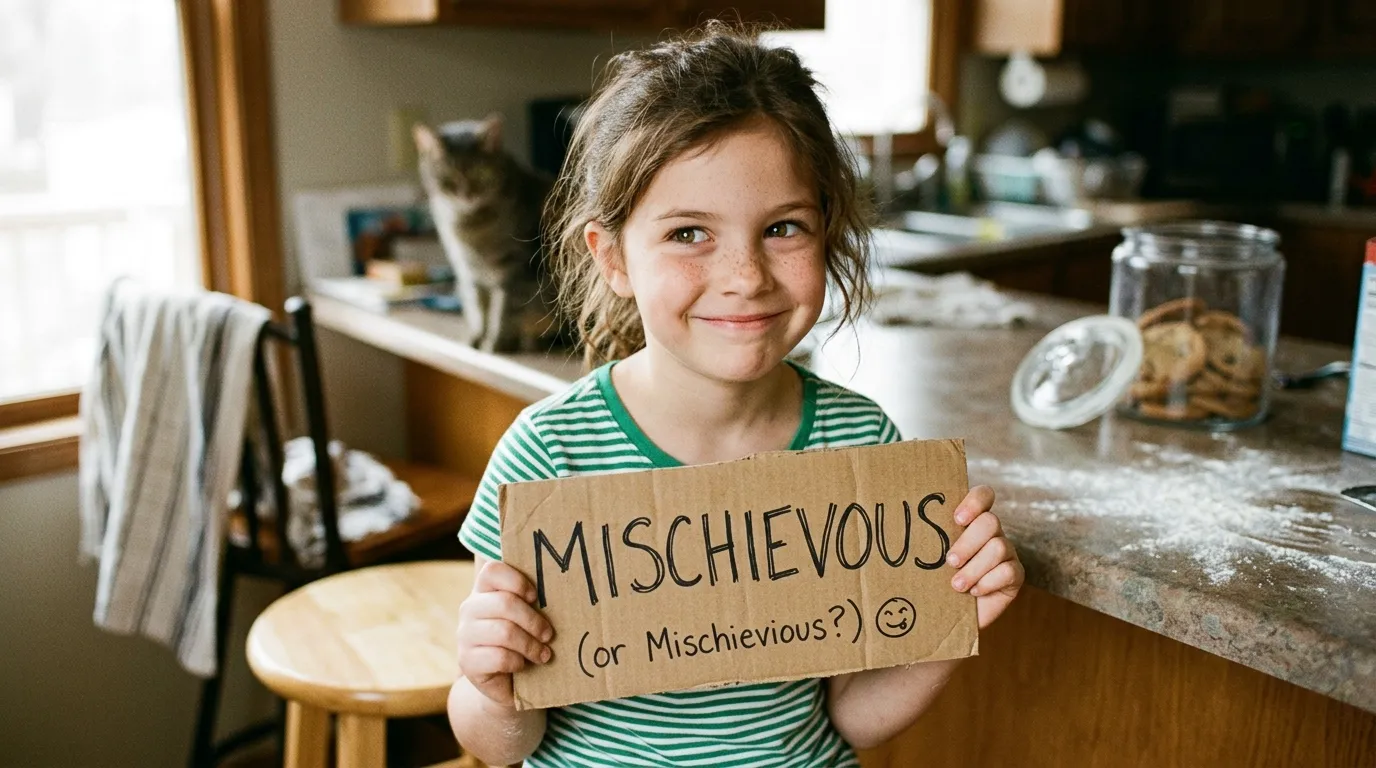
Many English learners, students, writers, and even native speakers wonder whether the correct spelling is mischievous or mischievious. Since the two spellings look almost identical, they are often confused in writing. However, only one spelling is correct in standard English. The correct spelling is mischievous, while mischievious is a common misspelling.
The word mischievous is widely used in everyday conversations, literature, education, parenting, and entertainment. It describes someone or something that playfully causes trouble, enjoys harmless pranks, or behaves in a cheeky way without intending serious harm. It can describe children, pets, fictional characters, or even a playful smile. Whether you’re talking about a mischievous child, a mischievous grin, or a mischievous puppy, mischievous is always the correct spelling.
Many people mistakenly write mischievious because they confuse the spelling with the incorrect pronunciation “mis-CHEE-vee-us.” In reality, the word is spelled mischievous, without the extra “i” after the “v.” Learning the correct spelling, pronunciation, grammar, examples, etymology, and memory tricks will help you avoid this common spelling mistake.
The spelling mischievous is the same in both American English and British English, so there are no regional spelling differences to remember.
Quick Answer
| Word | Correct? |
|---|---|
| ✅ Mischievous | Correct |
| ❌ Mischievious | Incorrect |
Mischievous means playfully causing trouble or behaving in a cheeky, harmless way.
Examples
- The mischievous puppy hid my shoes.
- She gave him a mischievous smile.
Mischievious is not a correct English spelling.
What Does Mischievous Mean?
Mischievous is an adjective.
It describes:
- Someone who enjoys harmless pranks.
- Playful or naughty behavior.
- Actions intended for fun rather than harm.
- A cheeky or teasing personality.
Examples
- The mischievous child hid his sister’s toys.
- Our cat has a mischievous personality.
- She flashed a mischievous grin.
- The boys planned a mischievous prank.
Grammar Role of Mischievous
Mischievous functions as an adjective.
Common Expressions
- Mischievous child
- Mischievous smile
- Mischievous grin
- Mischievous behavior
- Mischievous puppy
- Mischievous laugh
- Mischievous look
- Mischievous sense of humor
Examples
- The little girl had a mischievous smile.
- His mischievous behavior amused everyone.
Mischievous in American English
American English always uses mischievous.
Examples
- The mischievous puppy chewed the slippers.
- She gave me a mischievous smile.
- His mischievous joke made everyone laugh.
- The child has a mischievous personality.
- Their mischievous behavior was harmless.
Mischievous in British English
British English also uses mischievous.
Examples
- The mischievous boy hid the keys.
- She wore a mischievous grin.
- The puppy looked mischievous.
- His mischievous nature entertained everyone.
- They enjoyed their mischievous adventure.
There is no spelling difference between UK and US English.
Mischievous vs Mischievious Comparison Table
| Feature | Mischievous | Mischievious |
|---|---|---|
| Correct spelling | ✅ Yes | ❌ No |
| Dictionary word | Yes | No |
| Meaning | Playfully causing trouble | No meaning |
| Grammar | Adjective | Incorrect spelling |
| American English | Correct | Incorrect |
| British English | Correct | Incorrect |
| Professional writing | Recommended | Never use |
Pronunciation Guide
Mischievous
IPA (UK): /ˈmɪs.tʃɪ.vəs/
IPA (US): /ˈmɪs.tʃə.vəs/
Pronounced:
MIS-chuh-vuhs
Notice that there is no extra “i” before the final syllable.
Why Do People Confuse Mischievous and Mischievious?
People often write mischievious because:
- They pronounce the word incorrectly as “mis-chee-vee-us.”
- They mistakenly add an extra “i.”
- Long words are easier to misspell.
- Fast typing increases spelling errors.
Remember:
Mischievous has only one “i” after “ch.”
Word Origin and Etymology
The word mischievous comes from the noun mischief, which originated from Old French meschief, meaning harm, trouble, or misfortune. Over time, the adjective mischievous came to describe playful or harmless troublemaking rather than serious wrongdoing.
Mischievous Synonyms
| Synonym | Meaning |
|---|---|
| Naughty | Playfully disobedient |
| Playful | Full of fun |
| Cheeky | Bold in a humorous way |
| Impish | Full of harmless mischief |
| Teasing | Playfully provoking |
| Prankish | Fond of practical jokes |
American English Preferences
- Mischievous
- Naughty
- Playful
British English Preferences
- Mischievous
- Cheeky
- Impish
Mischievous vs Related Words
| Word | Meaning |
|---|---|
| Mischievous | Playfully causing trouble |
| Mischief | Playful trouble |
| Naughty | Slightly disobedient |
| Playful | Fun-loving |
| Cheeky | Bold and amusing |
Examples
- The child is mischievous.
- The prank caused harmless mischief.
- The puppy is playful.
- She gave a cheeky smile.
Grammar Rule Behind Mischievous
Always spell the word:
M-I-S-C-H-I-E-V-O-U-S
Notice:
- There is no extra “i” after “v.”
Do not write mischievious.
Common Mistakes and Corrections
1. Writing Mischievious
❌ The mischievious child hid my book.
✅ The mischievous child hid my book.
2. Adding an Extra “I”
❌ Mischievious
✅ Mischievous
3. Incorrect Email
❌ Your mischievious cat is adorable.
✅ Your mischievous cat is adorable.
4. School Assignment Error
❌ Describe a mischievious character.
✅ Describe a mischievous character.
5. Story Writing Mistake
❌ The mischievious monkey stole bananas.
✅ The mischievous monkey stole bananas.
6. Social Media Mistake
❌ My mischievious puppy made a mess.
✅ My mischievous puppy made a mess.
7. Greeting Card Error
❌ Wishing my mischievious little brother a happy birthday!
✅ Wishing my mischievous little brother a happy birthday!
Real-Life Examples
Emails
- Your mischievous puppy is adorable.
- Thank you for sharing the mischievous story.
Office
- He had a mischievous sense of humor.
- Her mischievous joke made everyone smile.
School
- The mischievous student played a harmless prank.
- Teachers handled the mischievous behavior calmly.
Literature
- The mischievous fairy tricked the travelers.
- The novel features a mischievous hero.
Parenting
- Toddlers can be naturally mischievous.
- Mischievous children often enjoy exploring.
Everyday Conversation
- My kitten is very mischievous.
- He gave me a mischievous grin.
American English Example Sentences
- The mischievous puppy chewed my shoes.
- She wore a mischievous smile.
- His mischievous joke made everyone laugh.
- The child enjoys mischievous games.
- Their mischievous behavior remained harmless.
- The kitten looked mischievous.
- He has a mischievous personality.
- The students planned a mischievous surprise.
- Her mischievous grin revealed the prank.
- The boy’s mischievous laughter filled the room.
British English Example Sentences
- The mischievous child hid the biscuits.
- She gave him a mischievous wink.
- The puppy looked particularly mischievous.
- Their mischievous antics amused everyone.
- He has a mischievous streak.
- The mischievous schoolboy apologised later.
- She wore a mischievous expression.
- The fairy was delightfully mischievous.
- Mischievous children often test boundaries.
- His mischievous humour made the class laugh.
Memory Tricks to Remember Mischievous
1. Remember the Base Word
Think:
Mischief → Mischievous
The spelling comes directly from mischief.
2. No Extra “I”
Never add another “i” after “v.”
3. Think of the Phrase
“Mischievous smile.”
You’ll often see these words together.
4. Break It Into Parts
Mis • chief • ous
This helps you remember the spelling.
5. Write It Three Times
Mischievous
Mischievous
Mischievous
Frequently Asked Questions
Is mischievous or mischievious correct?
Mischievous is correct.
What does mischievous mean?
It means playfully causing trouble or behaving in a cheeky, harmless way.
Is mischievious a word?
No.
How do you spell mischievous?
M-I-S-C-H-I-E-V-O-U-S
Is mischievous used in British English?
Yes.
Is mischievous used in American English?
Yes.
How do you pronounce mischievous?
MIS-chuh-vuhs
Is mischievous an adjective?
Yes.
What are synonyms of mischievous?
Naughty, playful, cheeky, impish, teasing, and prankish.
Why is mischievious incorrect?
Because the correct spelling does not include an extra “i” after the “v.”
People Also Ask
Why do people spell mischievous as mischievious?
Because many people pronounce it incorrectly as “mis-chee-vee-us,” leading them to insert an extra “i” in the spelling.
Is mischievous spelled differently in the UK and the US?
No. Both American English and British English use mischievous.
What is the easiest way to remember mischievous?
Remember the base word mischief. Since mischief doesn’t have an extra “i,” neither does mischievous.
Is mischievous formal or informal?
It is appropriate in both formal and informal English and is commonly used in literature, education, parenting, entertainment, and everyday conversation.
Conclusion
Understanding the difference between mischievous or mischievious is simple once you know the correct spelling. Mischievous is the only accepted spelling in standard English, while mischievious is a common misspelling caused by adding an unnecessary extra “i.”
The word mischievous describes someone or something that playfully causes trouble without intending serious harm. It is commonly used for children, pets, fictional characters, and humorous situations. Since American English and British English use the same spelling, there is only one correct form to remember.
A simple memory trick is “Think of the word ‘mischief’—then add ‘-ous.'” By remembering this rule and practicing the correct spelling, you’ll avoid a common English spelling mistake and write with greater confidence and accuracy.


