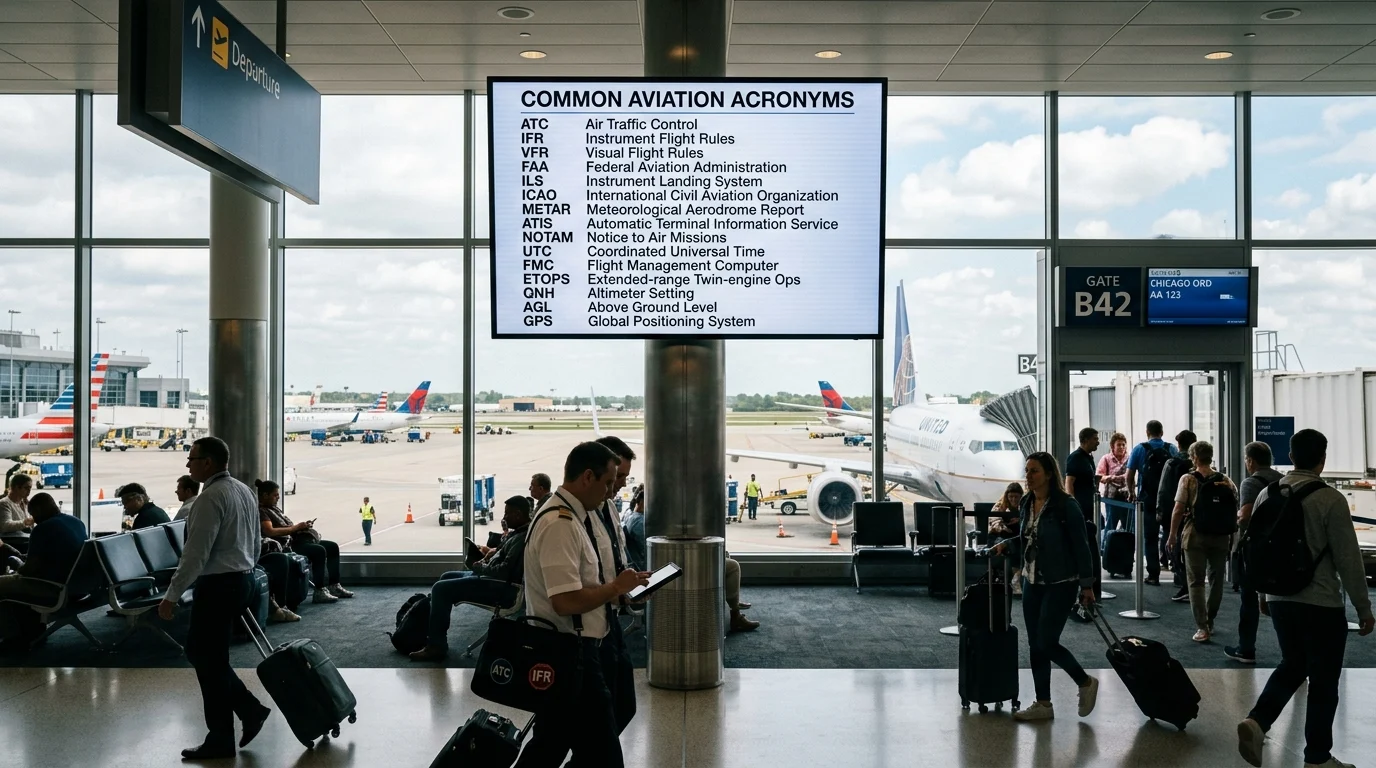
Flight acronyms are an essential part of aviation communication. Pilots, air traffic controllers, flight instructors, airline staff, and aviation students use these abbreviations daily to communicate clearly and efficiently.
Understanding flight acronyms can help you better understand aviation operations, pilot training, flight planning, weather reports, and air traffic control procedures.
What Are Flight Acronyms?
Flight acronyms are shortened aviation terms used to simplify communication and reduce errors in aviation operations.
They are commonly used in:
- Pilot training
- Airline operations
- Air traffic control
- Flight planning
- Aviation weather reporting
- Aircraft navigation
For example:
- ATC = Air Traffic Control
- IFR = Instrument Flight Rules
- VFR = Visual Flight Rules
Common Flight Acronyms List
| Acronym | Full Form | Purpose |
|---|---|---|
| ATC | Air Traffic Control | Manages aircraft movement |
| IFR | Instrument Flight Rules | Flying using instruments |
| VFR | Visual Flight Rules | Flying using visual references |
| FAA | Federal Aviation Administration | Aviation regulator |
| ILS | Instrument Landing System | Precision landing aid |
| GPS | Global Positioning System | Satellite navigation |
| VOR | VHF Omnidirectional Range | Radio navigation aid |
| DME | Distance Measuring Equipment | Distance navigation |
| METAR | Meteorological Aerodrome Report | Current weather report |
| TAF | Terminal Aerodrome Forecast | Airport weather forecast |
| NOTAM | Notice to Air Missions | Aviation notices |
| FMS | Flight Management System | Navigation computer |
| FMC | Flight Management Computer | Flight planning system |
| PPL | Private Pilot License | Pilot certification |
| CPL | Commercial Pilot License | Professional pilot certification |
| ATPL | Airline Transport Pilot License | Highest pilot qualification |
Air Traffic Control Acronyms
ATC (Air Traffic Control)
ATC manages aircraft movement on the ground and in the air.
Responsibilities include:
- Takeoff clearances
- Landing instructions
- Traffic separation
- Flight routing
ATC helps ensure safe and efficient air travel.
Flight Rules Acronyms
IFR (Instrument Flight Rules)
IFR allows pilots to fly using aircraft instruments when visibility is poor.
Used during:
- Clouds
- Rain
- Fog
- Night operations
Benefits of IFR
- Increased safety
- Reliable navigation
- Better traffic management
VFR (Visual Flight Rules)
VFR requires pilots to navigate primarily using outside visual references.
Typically used in:
- Good weather
- Daytime flying
- Training flights
Navigation Acronyms
GPS (Global Positioning System)
GPS uses satellites to determine an aircraft’s location.
Benefits include:
- Accurate navigation
- Route planning
- Real-time positioning
VOR (VHF Omnidirectional Range)
VOR is a radio navigation system that helps pilots determine their direction relative to a ground station.
DME (Distance Measuring Equipment)
DME provides distance information between an aircraft and a navigation station.
Landing System Acronyms
ILS (Instrument Landing System)
ILS provides precise guidance during landing.
It helps pilots:
- Maintain runway alignment
- Descend safely
- Operate in low visibility
ILS is commonly used at major airports worldwide.
Weather Acronyms
METAR
A METAR provides current weather information for airports.
Typical METAR data includes:
- Wind speed
- Visibility
- Temperature
- Cloud conditions
TAF
A TAF provides weather forecasts for airports.
Pilots use TAF reports for:
- Flight planning
- Fuel calculations
- Route selection
Safety and Information Acronyms
NOTAM (Notice to Air Missions)
NOTAMs alert pilots about important operational information such as:
- Runway closures
- Airspace restrictions
- Navigation equipment outages
- Temporary hazards
Checking NOTAMs is an essential part of pre-flight planning.
Flight Management Acronyms
FMS (Flight Management System)
The FMS helps automate navigation and flight planning.
Functions include:
- Route management
- Fuel monitoring
- Performance calculations
FMC (Flight Management Computer)
The FMC is the computer that powers the flight management system.
Pilots enter:
- Flight routes
- Altitudes
- Speed data
The FMC then assists with navigation throughout the flight.
Pilot Certification Acronyms
PPL (Private Pilot License)
Allows individuals to fly for personal purposes.
CPL (Commercial Pilot License)
Required for pilots who receive compensation for flying.
ATPL (Airline Transport Pilot License)
The highest level of pilot certification required by airline captains.
Why Flight Acronyms Are Important
Flight acronyms help:
- Improve communication
- Reduce misunderstandings
- Enhance flight safety
- Simplify technical information
- Support international aviation standards
Without standardized acronyms, aviation communication would be slower and more prone to errors.
Common Mistakes with Flight Acronyms
Confusing IFR and VFR
IFR uses instruments, while VFR relies on visual references.
Misinterpreting METAR and TAF
METAR reports current weather; TAF predicts future weather.
Ignoring NOTAMs
Missing important NOTAM information can affect flight safety.
Tips for Learning Flight Acronyms
Study a Few Each Day
Focus on commonly used terms first.
Use Flashcards
Create aviation acronym flashcards for practice.
Listen to Aviation Communications
Air traffic control recordings provide real-world examples.
Practice During Flight Training
Apply acronyms in realistic flight scenarios.
Frequently Asked Questions
What is the most common flight acronym?
ATC (Air Traffic Control) is one of the most frequently used aviation acronyms.
Are flight acronyms used worldwide?
Yes. Most aviation acronyms are internationally standardized.
Do pilots memorize all flight acronyms?
Pilots learn hundreds of acronyms during training and continue using them throughout their careers.
Final Thoughts
Flight acronyms are the foundation of aviation communication. Terms such as ATC, IFR, VFR, GPS, ILS, METAR, TAF, and NOTAM help pilots, controllers, and aviation professionals communicate accurately and safely.
Whether you are a student pilot, aviation enthusiast, or airline professional, learning these acronyms will improve your understanding of modern flight operations and aviation safety.


