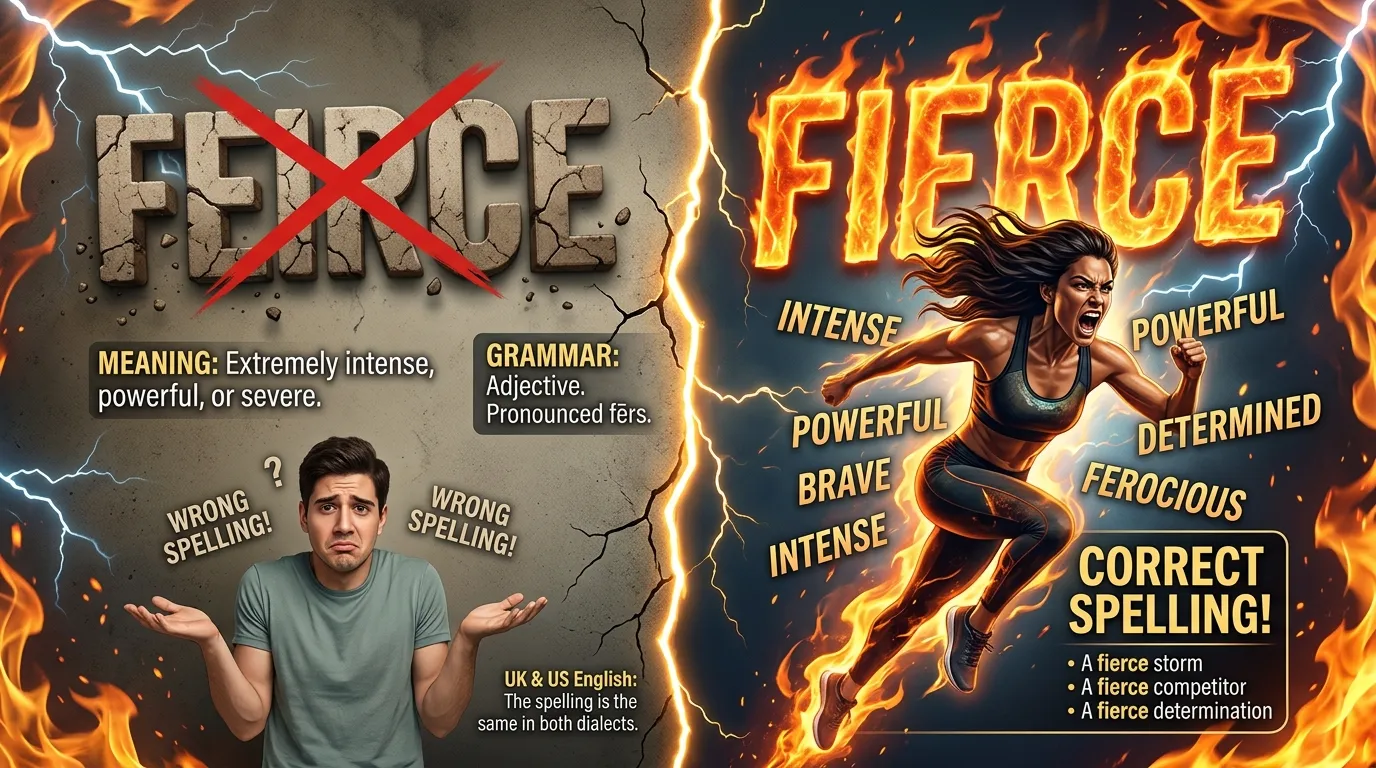
Have you ever wondered whether fierce or feirce is the correct spelling? You’re not alone. Many English learners, students, and even native speakers accidentally type feirce instead of fierce because the letters “i” and “e” can be confusing in English spelling. If you’ve searched for Fierce or Feirce, the simple answer is that fierce is the only correct English word, while feirce is a spelling mistake.
Understanding the difference between fierce or feirce helps improve your writing, spelling, and confidence in both formal and informal communication. Whether you’re writing an email, preparing school assignments, posting on social media, or creating professional documents, using the correct spelling matters.
The good news is that there is no difference between American English and British English in this case. Both the US and the UK dictionaries recognize fierce as the correct spelling, and feirce is considered incorrect.
Quick Answer
| ✅ Correct | ❌ Incorrect |
|---|---|
| Fierce | Feirce |
Correct spelling: ✅ Fierce
Incorrect spelling: ❌ Feirce
What Does “Fierce” Mean?
Fierce is an adjective.
It describes someone or something that is:
- Very strong
- Powerful
- Aggressive
- Intense
- Determined
- Wild
- Passionate
It can describe people, animals, emotions, weather, competition, and even fashion.
Examples
- The tiger looked fierce.
- She is a fierce competitor.
- We had a fierce storm last night.
- The debate became fierce.
- He gave a fierce performance.
Grammar: What Part of Speech Is “Fierce”?
Fierce is an adjective.
It modifies nouns.
Examples
- fierce animal
- fierce battle
- fierce competition
- fierce loyalty
- fierce determination
Comparative Form
- Fiercer
Example:
- This year’s competition is fiercer than last year’s.
Superlative Form
- Fiercest
Example:
- That was the fiercest storm in years.
American English Examples
Here are five examples commonly used in American English.
- She is a fierce basketball player.
- The company faces fierce competition.
- We drove through a fierce thunderstorm.
- The dog looked fierce, but it was friendly.
- Her speech received a fierce response online.
British English Examples
These examples sound natural in British English.
- The lion gave a fierce roar.
- There was fierce competition between the schools.
- A fierce wind swept across the coast.
- She is known for her fierce independence.
- The football match became fierce during the second half.
Why Is “Feirce” Wrong?
Feirce is not an English word.
It appears because people accidentally reverse the letters i and e while typing or spelling.
No major dictionary recognizes feirce.
These dictionaries list only fierce:
- Oxford Dictionary
- Cambridge Dictionary
- Merriam-Webster
- Collins Dictionary
- Macmillan Dictionary
Incorrect vs Correct Examples
| ❌ Incorrect | ✅ Correct |
|---|---|
| The dog looked feirce. | The dog looked fierce. |
| She is feirce in debates. | She is fierce in debates. |
| We had a feirce storm. | We had a fierce storm. |
| The competition was feirce. | The competition was fierce. |
| He gave a feirce speech. | He gave a fierce speech. |
Fierce or Feirce: Comparison Table
| Feature | Fierce | Feirce |
|---|---|---|
| Correct spelling | ✅ Yes | ❌ No |
| Dictionary word | Yes | No |
| Part of speech | Adjective | None |
| Meaning | Strong, intense, aggressive | No meaning |
| Used in UK English | Yes | No |
| Used in US English | Yes | No |
| Formal writing | Yes | Never |
| Informal writing | Yes | Never |
| Accepted in dictionaries | Yes | No |
Pronunciation Guide
Fierce
IPA (US): /fɪrs/
IPA (UK): /fɪəs/
Pronounced like:
“feers”
Feirce
There is no official pronunciation because it is not a recognized English word.
People may pronounce it like fierce, but it remains incorrect.
Why Are Fierce and Feirce Commonly Confused?
Several reasons explain this mistake.
- English spelling can be tricky.
- The letters i and e are often reversed.
- Fast typing causes errors.
- Autocorrect may not always catch mistakes.
- Learners remember the “i before e” rule incorrectly.
Remember:
The correct order is:
F I E R C E
Not
F E I R C E
Word Origin and Etymology
The word fierce has a long history.
It comes from:
- Middle English fers
- Old French fers
- Latin ferus, meaning wild or untamed
Over time, the meaning expanded to include:
- powerful
- violent
- intense
- determined
- passionate
The spelling feirce never developed as a legitimate English word.
Synonyms of Fierce
| Synonym | American English | British English | Best Use |
|---|---|---|---|
| Aggressive | Very common | Common | Competition |
| Intense | Very common | Very common | Emotions |
| Powerful | Common | Common | Performance |
| Strong | Very common | Very common | General |
| Ferocious | Common | Common | Animals |
| brutal | Common | Common | Wild behavior |
| Determined | Very common | Very common | Personality |
| Bold | Common | Common | Confidence |
| Tough | Very common | Common | Sports |
| Relentless | Common | Common | Business |
Example
Instead of saying:
“The market is fierce.”
You could say:
- The market is competitive.
- The market is intense.
- The market is aggressive.
Common Mistakes and How to Fix Them
1. Writing “Feirce”
❌ She is feirce.
✅ She is fierce.
2. Mixing the Letter Order
Always remember:
F-I-E-R-C-E
3. Thinking It Is a Verb
Wrong:
“I fierce the competition.”
Correct:
“I faced fierce competition.”
4. Using It as a Noun
Wrong:
“The fierce was amazing.”
Correct:
“The fierce performance was amazing.”
5. Forgetting Comparative Forms
Correct:
- fiercer
- fiercest
6. Using It in the Wrong Context
Wrong:
“I fierce my homework.”
Correct:
“My homework was difficult.”
7. Assuming UK and US Spell It Differently
Both countries use:
Fierce
Real-Life Examples
“Our company faces fierce competition this year.”
Office
“The team had a fierce discussion about the project.”
Banking
“Banks are facing fierce competition from online services.”
Invoice
“The supplier operates in a fierce market.”
School
“The students had fierce debates during class.”
Social Media
“Her fierce fashion style became viral.”
Rent Payment
“There is fierce demand for apartments in the city.”
Everyday Conversation
“My sister is fierce when defending her friends.”
Ten American English Sentences
- The startup faces fierce competition.
- She gave a fierce presentation.
- Our team fought a fierce battle.
- The coach is fierce but fair.
- We survived a fierce storm.
- The actress wore a fierce outfit.
- The debate became fierce.
- The eagle looked fierce.
- He has fierce determination.
- The online market is fierce.
Ten British English Sentences
- The wind became fierce overnight.
- The football rivalry is fierce.
- She has a fierce sense of justice.
- There was fierce opposition.
- The fox appeared fierce.
- Competition remains fierce.
- The argument turned fierce.
- Their loyalty is fierce.
- The waves were fierce.
- The campaign faced fierce criticism.
Fierce Compared with Related Words
| Word | Meaning | Difference |
|---|---|---|
| Fierce | Strong and intense | General use |
| Ferocious | Extremely violent | Mostly animals |
| Aggressive | Ready to attack or compete | Business and sports |
| Powerful | Having great strength | Neutral meaning |
| Intense | Very strong emotionally | Feelings and situations |
| brutal | Wild and cruel | Stronger negative meaning |
Grammar Rule for Beginners
Since fierce is an adjective, it describes a noun.
Pattern
Adjective + Noun
Examples
- fierce tiger
- fierce debate
- fierce competitor
Or
Verb + Adjective
- The dog looks fierce.
- The competition became fierce.
Never use fierce as a verb.
Memory Tricks
Here are five easy ways to remember the spelling.
1. Remember “FI”
The word starts with:
FI
not
FE
2. Think of Fire
Fire is powerful.
Fierce starts similarly.
3. Learn the Pattern
F-I-E-R-C-E
Practice writing it several times.
4. Read It Aloud
Say:
“Feers”
while writing:
Fierce
5. Use Flashcards
Write:
✅ Fierce
❌ Feirce
Review them daily.
Frequently Asked Questions
Is fierce or feirce correct?
Fierce is correct. Feirce is incorrect.
What does fierce mean?
It means strong, intense, aggressive, determined, or powerful.
Is feirce in the dictionary?
No.
How do you pronounce fierce?
US IPA:
/fɪrs/
UK IPA:
/fɪəs/
Is fierce used in formal writing?
Yes.
It is suitable for academic, business, and professional writing.
Is there a UK vs US spelling difference?
No.
Both spell it fierce.
What is a synonym for fierce?
Some common synonyms include:
- aggressive
- intense
- powerful
- ferocious
- determined
Can fierce describe people?
Yes.
Example:
“She is a fierce leader.”
Is fierce positive or negative?
It depends on the context. It can be positive (fierce determination, fierce loyalty) or negative (fierce attack, fierce argument).
People Also Ask
Why do people spell fierce as feirce?
Most people accidentally reverse the letters i and e because English spelling patterns can be confusing, especially when typing quickly.
Is “feirce” ever accepted?
No. Standard dictionaries and style guides do not recognize feirce as a correct spelling.
Can “fierce” describe fashion?
Yes. In modern English, especially in fashion and pop culture, fierce can describe someone who looks confident, stylish, and striking.
What is the opposite of fierce?
Common antonyms include gentle, calm, mild, peaceful, and soft.
Is “fierce” appropriate in business writing?
Yes. It’s commonly used to describe fierce competition, fierce negotiations, or fierce market rivalry in professional contexts.
Conclusion
If you’ve been unsure about Fierce or Feirce, the answer is simple: fierce is the only correct spelling, while feirce is a common misspelling that should be avoided. The word fierce is a widely used adjective that describes strength, intensity, determination, aggression, or powerful emotions. It is accepted in both American English and British English, with no spelling differences between the two.
By understanding its meaning, grammar, pronunciation, history, and real-life usage, you’ll be able to use fierce with confidence in school assignments, professional emails, social media posts, and everyday conversations. Remember the simple spelling pattern F-I-E-R-C-E, practice with example sentences, and use the memory tricks in this guide. With a little practice, you’ll never confuse fierce and feirce again.


