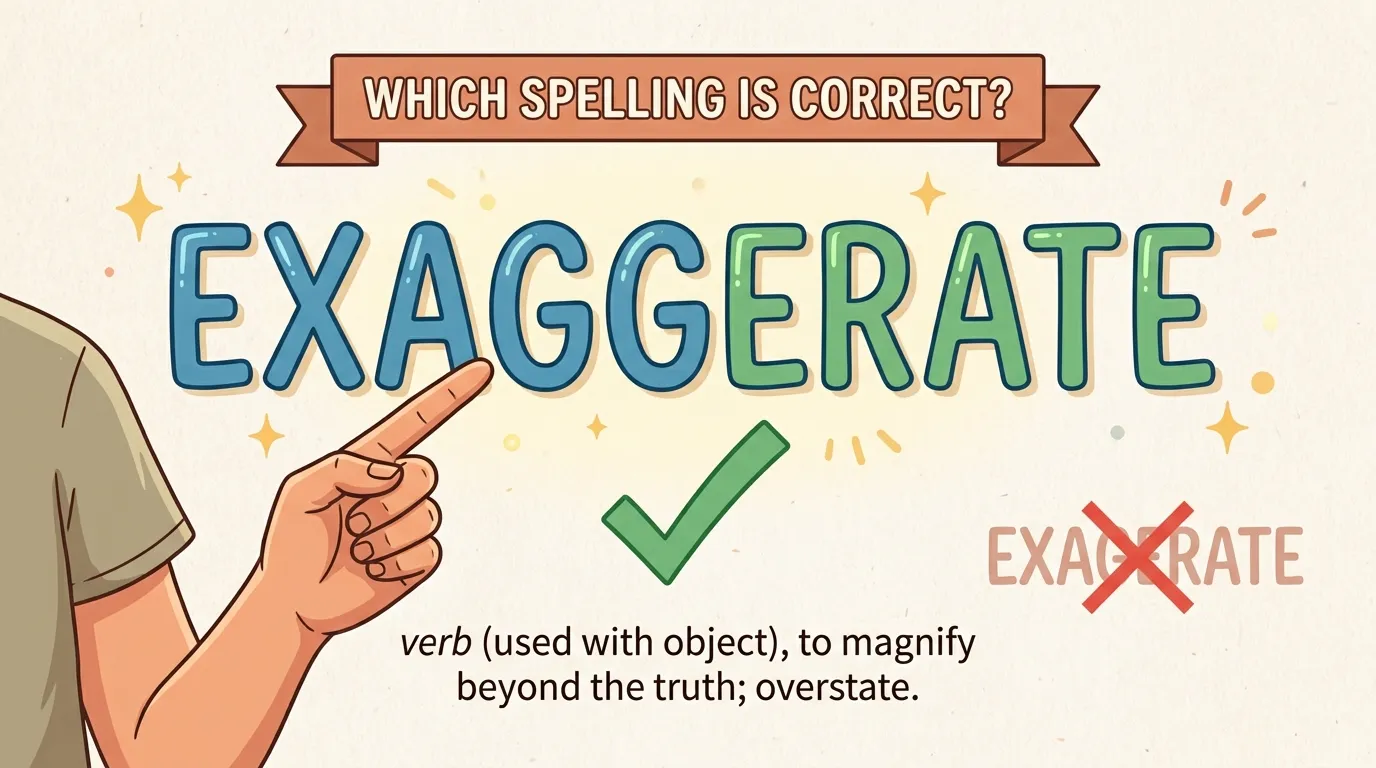
Have you ever wondered whether you should write exaggerate or exagerate? The quick answer is simple: exaggerate is the correct spelling, while exagerate is a spelling mistake. Even though many people accidentally type exagerate, dictionaries, grammar guides, and style manuals all recognize only exaggerate as the correct English word.
This spelling confusion happens because English pronunciation can be tricky. When people hear the word, they often think there is only one g in the middle. As a result, they write exagerate instead of exaggerate. This mistake appears in emails, school assignments, business documents, social media posts, and even professional writing.
The good news is that there is no difference between American English and British English for this word. Both US and UK English use the spelling exaggerate. If you want to improve your writing, understanding the correct spelling, pronunciation, grammar, and usage will help you avoid one of the most common English spelling mistakes.
Quick Answer
| ✅ Correct | ❌ Incorrect |
|---|---|
| Exaggerate | Exagerate |
Correct: Exaggerate (verb)
Incorrect: Exagerate (not an accepted English word)
Both American English and British English use exaggerate.
What Does “Exaggerate” Mean?
Exaggerate means to make something seem bigger, better, worse, more important, or more dramatic than it really is.
Grammatical Role
- Part of Speech: Verb
- Regular Verb
- Can be used in present, past, and future tenses.
Verb Forms
| Form | Word |
|---|---|
| Base Form | exaggerate |
| Third Person | exaggerates |
| Present Participle | exaggerating |
| Past Tense | exaggerated |
| Past Participle | exaggerated |
When Should You Use “Exaggerate”?
Use exaggerate whenever someone:
- Overstates facts
- Makes a story more dramatic
- Describes something as larger than reality
- Adds unnecessary emphasis
- Inflates numbers or events
Examples:
- Don’t exaggerate your experience on your resume.
- He tends to exaggerate every story.
- She exaggerated the cost of the repair.
American English Examples
- Don’t exaggerate your job experience.
- My brother always exaggerates his fishing stories.
- The advertisement exaggerated the product’s benefits.
- She exaggerated the size of the problem.
- Never exaggerate your qualifications.
- He exaggerated the price of the car.
- The news report did not exaggerate the damage.
- Students sometimes exaggerate how difficult the exam was.
- I think you’re exaggerating the risk.
- The company exaggerated its sales numbers.
British English Examples
- Please don’t exaggerate the situation.
- He exaggerated the amount he paid for the house.
- The newspaper didn’t exaggerate the facts.
- She exaggerated her achievements during the interview.
- They exaggerated the delay.
- You’re exaggerating the issue.
- The witness exaggerated what happened.
- Some tabloids exaggerate celebrity stories.
- We shouldn’t exaggerate the costs.
- He exaggerated his role in the project.
Why Is “Exagerate” Wrong?
Exagerate is simply a misspelling.
No major English dictionary accepts it.
These dictionaries all list exaggerate:
- Oxford Dictionary
- Cambridge Dictionary
- Merriam-Webster
- Collins Dictionary
- Dictionary.com
Incorrect vs Correct Examples
| ❌ Incorrect | ✅ Correct |
|---|---|
| Don’t exagerate. | Don’t exaggerate. |
| She exagerated the story. | She exaggerated the story. |
| I never exagerate facts. | I never exaggerate facts. |
| Stop exagerating. | Stop exaggerating. |
| They exagerated the numbers. | They exaggerated the numbers. |
Exaggerate vs Exagerate Comparison Table
| Feature | Exaggerate | Exagerate |
|---|---|---|
| Meaning | Overstate something | No meaning |
| Correct spelling | Yes | No |
| Dictionary word | Yes | No |
| Part of speech | Verb | None |
| Used in UK English | Yes | No |
| Used in US English | Yes | No |
| Accepted in formal writing | Yes | No |
| Grammar | Correct | Incorrect |
| Example | Don’t exaggerate. | ❌ Don’t exagerate. |
Pronunciation Guide
| Word | IPA (US) | IPA (UK) |
|---|---|---|
| Exaggerate | /ɪɡˈzædʒ.ə.reɪt/ | /ɪɡˈzædʒ.ə.reɪt/ |
| Exagerate | Not recognized | Not recognized |
How to Say It
ig-ZAJ-uh-rate
Notice that pronunciation does not clearly reveal the double g, which is why people often misspell it.
Why Are These Words Commonly Confused?
People confuse these spellings because:
- English has many silent spelling patterns.
- The double g is difficult to hear.
- Fast typing causes spelling mistakes.
- Autocorrect sometimes misses errors.
- Many learners spell words based on sound instead of spelling.
Word Origin and Etymology
The word exaggerate comes from the Latin word exaggerare, meaning:
- to heap up
- to increase
- to enlarge
The Latin root combines:
- ex- = out
- aggerare = heap up
Over time, it entered Middle French before becoming part of English in the early 1500s.
The spelling has always included double g, which is why exagerate has never been the standard spelling.
Synonyms of Exaggerate
| Synonym | American English | British English |
|---|---|---|
| Overstate | Very common | Very common |
| Overemphasize | Common | Common |
| Magnify | Common | Common |
| Inflate | Common | Common |
| Embellish | Common | Common |
| Overplay | Common | Common |
| Stretch the truth | Informal | Informal |
| Blow out of proportion | Very common | Very common |
| Amplify | Common | Common |
| Dramatize | Common | Common |
Which Synonyms Are Preferred?
Both American and British English commonly use:
- overstate
- magnify
- inflate
Informal speech often uses:
- blow out of proportion
- stretch the truth
Grammar Rule Behind “Exaggerate”
Exaggerate is a regular verb.
Examples:
Present
- I exaggerate.
- You exaggerate.
Past
- I exaggerated.
- They exaggerated.
Future
- She will exaggerate.
Present Continuous
- He is exaggerating.
Past Continuous
- They were exaggerating.
Related Words
| Word | Meaning |
|---|---|
| Exaggeration | The act of exaggerating |
| Exaggerated | Made larger than reality |
| Exaggerating | Present participle |
| Overstate | Say more than true |
| Embellish | Add extra details |
Examples:
- That was an exaggeration.
- His reaction was exaggerated.
Common Mistakes and Corrections
1. Writing “Exagerate”
❌ I exagerate sometimes.
✅ I exaggerate sometimes.
2. Missing the Double G
❌ exagerated
✅ exaggerated
3. Wrong Verb Form
❌ He exaggerate yesterday.
✅ He exaggerated yesterday.
4. Confusing It with “Lie”
Exaggerating isn’t always lying.
You can exaggerate without completely inventing facts.
5. Using It as a Noun
❌ That is an exaggerate.
✅ That is an exaggeration.
6. Spelling “Exaggerating” Wrong
❌ exagerating
✅ exaggerating
7. Adding Extra Letters
❌ exaggerrate
✅ exaggerate
Real-Life Examples
Emails
Please don’t exaggerate the project’s progress in your report.
Office
The manager warned employees not to exaggerate sales figures.
Banking
Never exaggerate your income on a loan application.
Invoices
The supplier did not exaggerate the invoice amount.
Schools
Students often exaggerate how difficult homework is.
Social Media
Many influencers exaggerate their lifestyles online.
Rent Payments
Don’t exaggerate your financial problems when speaking with the landlord.
Everyday Conversation
I think you’re exaggerating how long we waited.
Exaggerate Compared with Related Words
| Word | Difference |
|---|---|
| Exaggerate | Makes something seem bigger than reality |
| Lie | States something false |
| Embellish | Adds decorative details |
| Overstate | Gives too much importance |
| Amplify | Increase strength or effect |
Example:
- He exaggerated the story.
- He lied about being there.
These are not always the same.
Memory Tricks
1. Remember the Double G
Think:
Big stories need BIG spelling.
Big → Double GG
2. Think of “Aggressive”
Aggressive also has double g.
So does exaggerate.
3. Remember “AG”
The middle contains:
AGG
Never AG
4. Picture a Giant Story
Imagine someone making a story bigger.
A bigger story deserves two Gs.
5. Use This Phrase
“Don’t exaggerate with one G—use two!”
Frequently Asked Questions
Is exaggerate or exagerate correct?
Exaggerate is correct.
Is exagerate a real word?
No. It is a spelling mistake.
Why do people spell exaggerate incorrectly?
Because the double g is difficult to hear in pronunciation.
Is there a difference between UK and US English?
No.
Both countries spell it exaggerate.
What is the noun form?
Exaggeration
What is the adjective form?
Exaggerated
What is a synonym for exaggerate?
Common synonyms include:
- overstate
- magnify
- inflate
- embellish
Is exaggerate formal?
Yes.
It works in:
- academic writing
- business writing
- legal documents
- everyday conversation
How do you pronounce exaggerate?
US and UK:
/ɪɡˈzædʒ.ə.reɪt/
People Also Ask
Is “exagerate” accepted in any dictionary?
No. Standard English dictionaries recognize only exaggerate.
How can I remember the correct spelling?
Remember that exaggerate contains two Gs, just like a story that becomes “twice as big.”
Is “exaggerate” used in business writing?
Yes. It is commonly used in reports, contracts, marketing discussions, and professional emails when talking about overstated claims.
Can “exaggerate” be used in formal and informal situations?
Yes. It is appropriate in both formal writing and everyday conversation.
What is the difference between “exaggerate” and “overstate”?
They are very similar, but overstate is often used in formal contexts, while exaggerate is common in both formal and casual speech.
Conclusion
When choosing between exaggerate and exagerate, the answer is clear: exaggerate is the only correct spelling in both American and British English. The form exagerate is simply a misspelling and should be avoided in every type of writing, from school assignments and business emails to social media posts and everyday messages. Remember that exaggerate is a regular verb meaning to make something seem greater, larger, or more important than it really is. Learning its spelling, pronunciation, verb forms, and common uses will help you write with greater confidence and accuracy.
A simple way to remember it is that a “bigger” story deserves two Gs. By using the tips, examples, grammar rules, and memory tricks in this guide, you’ll be able to recognize the correct form instantly and avoid this common spelling mistake in both formal and informal English.


