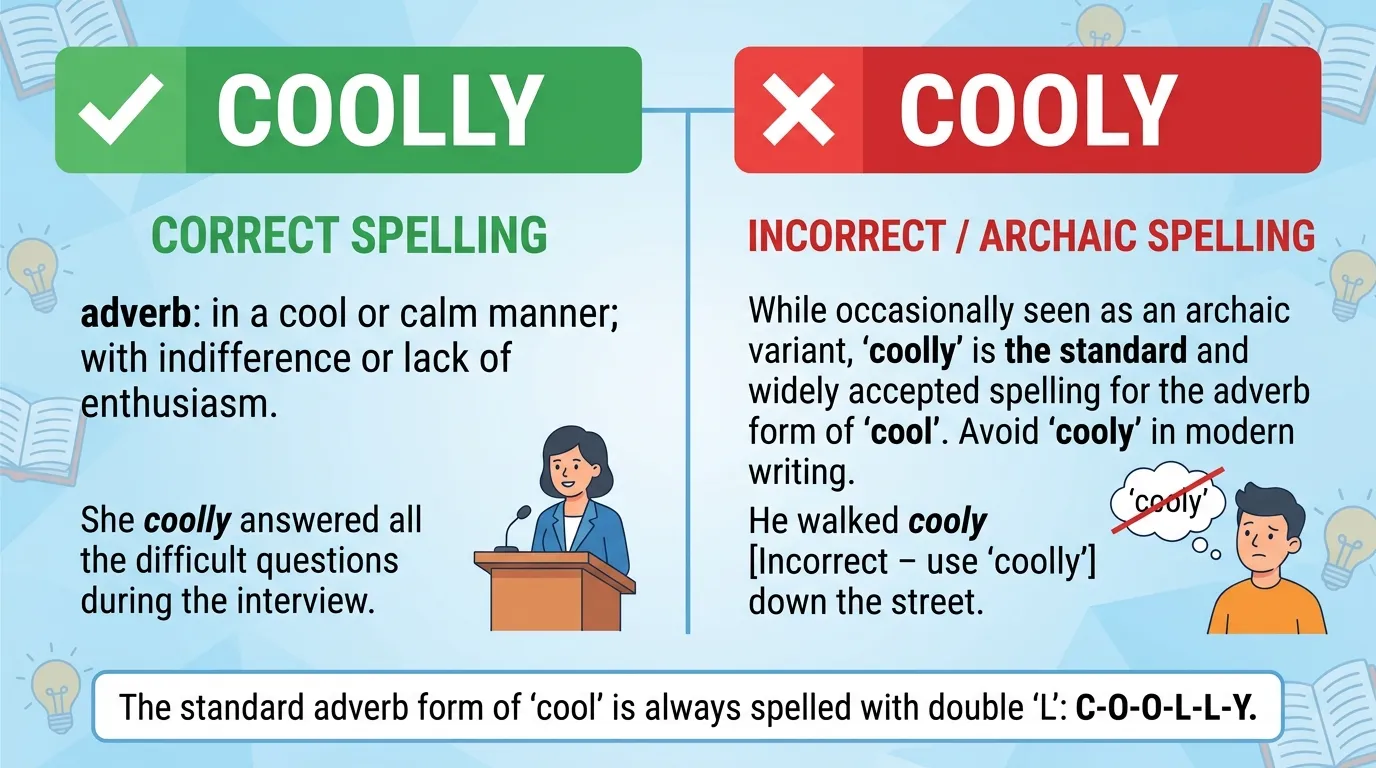
If you are unsure whether “coolly” or “cooly” is the correct spelling, the answer is simple: coolly is the standard and correct spelling in modern English.
The word coolly is the adverb form of cool. It means in a calm, unemotional, controlled, or composed manner. For example:
She coolly explained why she disagreed.
The spelling cooly is generally considered a misspelling when you intend to use the adverb meaning “in a cool manner.” Although you may occasionally encounter cooly in older, historical, dialectal, or informal material, it is not the standard spelling recommended in contemporary American English.
This guide explains coolly vs cooly, including their meanings, pronunciation, grammar, history, usage, differences, common mistakes, synonyms, examples, and regional considerations. By the end, you will know exactly when to use coolly and why cooly is usually best avoided.
Quick Answer: Coolly or Cooly?
Coolly is the correct standard spelling.
| Word | Standard English? | Meaning | Recommended? |
|---|---|---|---|
| coolly | Yes | In a calm, composed, unemotional, or controlled manner | ✅ Yes |
| cooly | Generally no | Intended as an alternative spelling of coolly | ❌ Usually avoid |
Correct examples
- He coolly rejected the offer.
- She coolly handled the difficult question.
- The player coolly scored the winning goal.
- He coolly walked away from the argument.
Incorrect or nonstandard examples
- He cooly rejected the offer.
- She cooly handled the situation.
- The player cooly scored the goal.
For standard American English, academic writing, professional communication, journalism, and most published content, use coolly.
What Does Coolly Mean?
Coolly is an adverb meaning in a calm, controlled, unemotional, detached, or sometimes unfriendly manner.
It comes from the adjective cool.
Consider this sentence:
The manager coolly responded to the criticism.
Here, coolly tells us how the manager responded. The manager did not become angry or emotional. Instead, the response was calm and controlled.
Depending on context, coolly can have either a positive or negative sense.
Positive meaning of coolly
It can describe someone who remains calm under pressure.
The firefighter coolly assessed the situation.
This suggests self-control and good judgment.
Negative meaning of coolly
It can also suggest emotional distance, indifference, or a lack of warmth.
She coolly dismissed his apology.
Here, coolly suggests that she was detached or unfriendly.
Therefore, coolly does not always mean “calmly” in a positive way. Context determines whether the word sounds admirable, detached, aloof, or even hostile.
Is Cooly a Correct Word?
In modern standard English, cooly is not the normal spelling of the adverb formed from cool.
The standard form is:
cool + ly = coolly
The doubled l is important.
This follows the conventional spelling pattern used when the adjective already ends in l and the suffix -ly is added.
Compare:
- cool → coolly
- full → fully
- dull → dully
- skillful → skillfully
- careful → carefully
Although English spelling has many exceptions and historical variations, coolly is the form you should use in ordinary contemporary writing.
Why might you see “cooly”?
There are several possible reasons:
- It may simply be a spelling mistake.
- It may be an informal or nonstandard spelling.
- It may appear in older texts.
- It may occur in dialectal writing.
- Someone may assume that cool + ly should be spelled cooly.
For modern readers, however, cooly can look like an error.
Coolly vs Cooly: The Main Difference
The central difference is spelling and standard usage.
Coolly is the established standard adverb.
Cooly is generally not the standard modern spelling for this meaning.
| Feature | Coolly | Cooly |
|---|---|---|
| Part of speech | Adverb | Usually a nonstandard spelling |
| Standard modern English | Yes | No, in this sense |
| Meaning | In a calm, controlled, or detached way | Usually intended to mean coolly |
| American English | Standard | Avoid |
| British English | Standard | Avoid in ordinary writing |
| Academic writing | Recommended | Not recommended |
| Business writing | Recommended | Not recommended |
| Casual texting | Understandable but unnecessary | May appear as a typo |
| Pronunciation | /ˈkuːlli/ | Usually intended to sound like coolly |
If you need a reliable rule, remember:
When you mean “in a cool manner,” spell it coolly.
Why Do People Confuse Coolly and Cooly?
The confusion comes largely from the way -ly works in English.
Many adjectives form adverbs by adding -ly:
- quick → quickly
- quiet → quietly
- slow → slowly
- careful → carefully
- serious → seriously
So it is natural for someone to think:
cool + ly = cooly
But English spelling does not always work by simply attaching letters without considering the existing word.
The standard spelling is:
coolly
The second l remains because the base adjective is cool.
A simple comparison
Think of the word as:
COOL + LY
This gives:
COOLLY
Not:
COOLY
The spelling preserves the l from cool and adds the -ly suffix.
How Do You Pronounce Coolly?
Coolly is pronounced approximately:
KOOL-lee
Its pronunciation is:
/ˈkuːlli/
It has two syllables:
cool-ly
The first syllable sounds like cool, and the second sounds like lee.
Example
He coolly answered the question.
You would naturally pronounce it as:
KOOL-lee answered the question.
The spelling may look slightly unusual because of the double l, but the pronunciation is straightforward.
What Part of Speech Is Coolly?
Coolly is an adverb.
Adverbs commonly describe verbs, adjectives, other adverbs, or entire clauses. In this case, coolly most often modifies a verb by explaining how an action is performed.
Examples
She coolly refused.
Coolly modifies refused.
He coolly handled the pressure.
Coolly modifies handled.
The lawyer coolly questioned the witness.
Coolly modifies questioned.
The related forms are:
| Word | Part of Speech | Example |
|---|---|---|
| cool | Adjective | She remained cool. |
| coolness | Noun | His coolness impressed everyone. |
| coolly | Adverb | He responded coolly. |
| cool | Verb | Let the soup cool. |
What Does Cool Mean Before It Becomes Coolly?
Understanding cool helps explain coolly.
The adjective cool can describe temperature:
The room was cool.
But it can also describe someone’s emotional behavior:
She remained cool during the crisis.
From this second meaning, coolly develops naturally:
She coolly handled the crisis.
In this context, coolly means without panic, excitement, or visible emotional distress.
The word can also describe a socially distant attitude:
He coolly ignored the criticism.
Here, it suggests emotional detachment rather than simply good self-control.
Coolly Can Mean Calmly—but Not Always
One important nuance is that coolly and calmly are not always perfect synonyms.
Calmly
Calmly usually emphasizes a peaceful absence of agitation.
She calmly explained the instructions.
Coolly
Coolly can emphasize emotional control or detachment.
She coolly explained why the proposal was unacceptable.
The second sentence can sound more distant or firm.
Compare these examples
He calmly answered the question.
This sounds neutral and peaceful.
He coolly answered the question.
This can suggest that he remained emotionally detached or deliberately controlled.
Therefore, choose coolly when the idea of emotional distance, composure, or controlled behavior matters.
Coolly vs Calmly
These words are related but have different shades of meaning.
| Word | Main idea | Possible tone |
|---|---|---|
| Coolly | Controlled, detached, unemotional | Calm, distant, confident |
| Calmly | Peaceful and without agitation | Neutral, reassuring |
| Collectedly | In a composed manner | Formal |
| Composedly | With self-control | Formal |
| Impassively | Without showing emotion | More emotionally detached |
| Casually | Without apparent concern or formality | Informal |
Example
The surgeon calmly explained the procedure.
The focus is reassurance and lack of panic.
The negotiator coolly rejected the proposal.
The focus is controlled, firm, and possibly detached behavior.
Coolly in Everyday English
You can use coolly in many everyday situations.
Conversations
She coolly told him that she was not interested.
Arguments
He coolly explained his side of the story.
Work
The manager coolly handled the complaint.
Sports
The striker coolly converted the penalty.
Competition
She coolly made the final decision under pressure.
Personal relationships
He coolly responded to her message.
The word is especially useful when describing someone who does not allow emotions to control their behavior.
Coolly in Sports Writing
Coolly is particularly common in sports journalism.
Sports writers frequently use it to describe an athlete who performs successfully under pressure.
Examples include:
- The striker coolly finished the chance.
- The goalkeeper coolly saved the penalty.
- She coolly converted the final shot.
- The quarterback coolly led the team down the field.
- He coolly delivered the winning serve.
In these examples, coolly usually has a positive meaning.
It suggests:
- confidence
- composure
- self-control
- skill under pressure
- lack of panic
A sports headline might describe an athlete as having coolly secured a victory.
Coolly in Business and Professional Writing
In professional contexts, coolly can be useful when describing negotiation, decision-making, or conflict management.
Examples:
The executive coolly rejected the proposed terms.
The negotiator coolly addressed each concern.
The team leader coolly responded to the unexpected criticism.
However, writers should be aware that coolly can imply emotional distance.
If you want a clearly positive professional tone, alternatives such as calmly, professionally, or composedly may sometimes be better.
Compare
She coolly handled the complaint.
This could suggest professionalism, but also some emotional distance.
She calmly handled the complaint.
This sounds more clearly positive.
Coolly in Academic Writing
Coolly is grammatically acceptable in academic writing, but its usefulness depends on context.
For example:
The researcher coolly evaluated the competing claims.
This is grammatically correct, but academic writing may prefer a more precise word:
The researcher objectively evaluated the competing claims.
If you are describing emotional restraint, however, coolly may be appropriate.
The author coolly challenges the assumptions underlying the theory.
Here, the word conveys a controlled, detached approach.
Coolly in Journalism
Journalists often use coolly when describing politicians, public figures, athletes, negotiators, and other people facing pressure.
Examples:
The senator coolly dismissed the accusation.
The candidate coolly answered questions from reporters.
The coach coolly responded to criticism after the game.
The word can subtly communicate the writer’s interpretation of someone’s behavior. It may portray the person as:
- composed
- confident
- detached
- unemotional
- aloof
- dismissive
Therefore, journalists should use it carefully when tone matters.
Is Coolly Formal or Informal?
Coolly is neutral to moderately formal.
It is not slang.
You can use it in:
- everyday writing
- journalism
- business writing
- essays
- literature
- professional communication
- sports reporting
It may sound more literary than simply saying calmly, but it is still a normal English word.
Formal example
The committee coolly rejected the proposal after reviewing the evidence.
Everyday example
He coolly told me he wasn’t worried.
Both are natural.
Regional Differences: American vs British English
There is no major American-British spelling difference between coolly and cooly.
Both American English and British English use:
coolly
for the standard adverb.
Unlike words such as color/colour, center/centre, or realize/realise, this is not a significant US-versus-UK spelling issue.
American English
She coolly responded to the criticism.
British English
She coolly responded to the criticism.
The same spelling is standard in both varieties.
Other English-speaking regions also generally favor coolly in standard edited English.
The Word History of Coolly
The history of coolly is closely connected to the long history of the word cool.
The word cool originally referred primarily to a relatively low temperature. Over time, English speakers began using temperature-related language metaphorically to describe emotional states.
A person who remained physically “cool” could be imagined as someone who did not become overheated by anger, excitement, or fear.
This led to meanings associated with:
- emotional restraint
- self-control
- composure
- calmness
- detachment
The adverb coolly developed from this adjective and came to describe actions performed with this controlled emotional quality.
The modern word therefore has both a literal temperature-related background and a strongly established figurative emotional meaning.
Synonyms for Coolly
The best synonym depends on the intended meaning.
If you mean calmly
- calmly
- peacefully
- quietly
- steadily
- composedly
If you mean confidently
- confidently
- assuredly
- decisively
- self-assuredly
If you mean without emotion
- impassively
- unemotionally
- dispassionately
- stoically
- objectively
If you mean coldly or distantly
- coldly
- distantly
- indifferently
- aloofly
- reservedly
Be careful when replacing coolly with a synonym because each word carries a slightly different emotional tone.
Antonyms of Coolly
Depending on context, possible antonyms include:
- emotionally
- excitedly
- angrily
- nervously
- anxiously
- impulsively
- passionately
- frantically
- hysterically
For example:
He coolly responded to the accusation.
An opposite version might be:
He angrily responded to the accusation.
The contrast is between emotional control and visible emotional intensity.
Common Collocations With Coolly
A collocation is a combination of words that commonly appear together.
Some natural collocations with coolly include:
- coolly respond
- coolly reject
- coolly dismiss
- coolly explain
- coolly handle
- coolly assess
- coolly observe
- coolly state
- coolly remark
- coolly accept
- coolly refuse
- coolly calculate
- coolly walk away
- coolly confront
- coolly answer
Examples
She coolly dismissed the criticism.
He coolly assessed the situation.
The player coolly converted the penalty.
The manager coolly explained the decision.
These combinations sound natural because they frequently describe controlled behavior.
Common Phrases Using Coolly
Although coolly is not part of many fixed idioms, it appears naturally in descriptive phrases.
“Coolly dismiss”
She coolly dismissed the accusation.
Meaning: She rejected it without showing much emotion.
“Coolly respond”
He coolly responded to the criticism.
Meaning: He responded without becoming visibly upset.
“Coolly handle”
The nurse coolly handled the emergency.
Meaning: She remained composed while dealing with a difficult situation.
“Coolly calculate”
The player coolly calculated his next move.
Meaning: He thought carefully without panicking.
Common Mistakes With Coolly
Mistake 1: Writing “cooly”
❌ He cooly answered the question.
✅ He coolly answered the question.
Mistake 2: Assuming one L is enough
Because the pronunciation does not strongly emphasize the second l, some writers leave it out.
❌ cooly
✅ coolly
Mistake 3: Using coolly when calmly is clearer
She coolly helped the frightened child.
This is grammatically possible, but coolly might suggest emotional distance.
A better choice could be:
She calmly helped the frightened child.
Mistake 4: Assuming coolly always means positively calm
He coolly ignored her concerns.
This does not necessarily praise his composure. It may suggest indifference.
Awkward vs Natural Examples
Example 1
Awkward:
The teacher cooly answered the student’s question.
Natural:
The teacher coolly answered the student’s question.
Example 2
Awkward:
She cooly rejected the invitation.
Natural:
She coolly rejected the invitation.
Example 3
If you mean peaceful behavior:
Less precise:
The mother coolly comforted the child.
More natural:
The mother calmly comforted the child.
Here, calmly better communicates warmth and reassurance.
Example 4
For a competitive situation:
The athlete coolly took the winning shot.
This is highly natural because it emphasizes composure under pressure.
Coolly vs Coldly
These words are sometimes confused because they can both describe emotional distance.
Coolly
Usually emphasizes control, composure, or detachment.
She coolly handled the confrontation.
Coldly
Usually emphasizes lack of warmth, sympathy, or kindness.
She coldly rejected his request.
The difference can be subtle.
Someone can act coolly without being cruel.
Someone who acts coldly is more likely to appear unfriendly or emotionally harsh.
Coolly vs Casually
These words can also overlap, but they are not interchangeable.
Casually means in a relaxed, informal, or unconcerned way.
He casually mentioned the problem.
Coolly means in a controlled or emotionally detached way.
He coolly mentioned the problem.
The second sentence suggests more emotional control or distance.
Coolly vs Indifferently
Indifferently means showing little interest, concern, or emotion.
Coolly can imply indifference, but it does not necessarily do so.
She coolly considered the proposal.
This could mean she evaluated it calmly and objectively.
She indifferently considered the proposal.
This strongly suggests that she did not care much about it.
Is Coolly Used in Slang?
Coolly is not primarily a slang term.
The adjective cool has many slang meanings, including:
- fashionable
- impressive
- excellent
- acceptable
- socially desirable
For example:
That’s a cool jacket.
But coolly usually retains its standard adverbial meaning of acting in a controlled, calm, or detached way.
It is therefore important not to assume that:
cool = fashionable
automatically means:
coolly = fashionably.
That is generally not how modern English works.
Does Coolly Have a Political Meaning?
There is no special political definition of coolly.
However, political journalism frequently uses the word to describe how politicians react to criticism, questions, negotiations, scandals, or opposition.
For example:
The candidate coolly dismissed the accusation.
The word describes the candidate’s manner rather than expressing a specific political concept.
Because it can suggest confidence, detachment, or dismissiveness, political writers should consider whether the word accurately reflects the observable behavior.
Does Coolly Have a Technical Meaning?
Coolly does not have a widely established technical meaning distinct from its ordinary English meaning.
However, technical or professional writers may use it descriptively.
For example:
The engineer coolly evaluated the system failure.
Here, coolly retains its ordinary meaning of calmly or objectively.
In scientific or technical writing, more precise terms such as objectively, systematically, or without bias may be preferable when those concepts are actually intended.
How to Remember the Correct Spelling
A simple memory trick is:
COOL + LY = COOLLY
Think of the base word first:
COOL
Then add:
LY
Together:
COOLLY
Another useful trick is to compare it with fully.
You do not write:
❌ fuly
You write:
✅ fully
Likewise:
❌ cooly
✅ coolly
The repeated consonant is part of the standard spelling.
A Simple Rule for Students and ESL Learners
If you are learning English, remember this rule:
Use “coolly” when you need the adverb meaning “in a calm, controlled, or emotionally detached way.”
Examples:
- He coolly answered.
- She coolly refused.
- They coolly handled the problem.
- The player coolly scored.
- The lawyer coolly questioned the witness.
Avoid cooly in standard English writing.
Which Form Should You Use in Different Types of Writing?
| Writing situation | Recommended form |
|---|---|
| American English | coolly |
| British English | coolly |
| Academic essay | coolly |
| Business email | coolly |
| Journalism | coolly |
| Sports writing | coolly |
| Technical writing | coolly if appropriate |
| Blog writing | coolly |
| Social media | coolly |
| Texting | coolly |
| Formal documents | coolly |
| Creative writing | coolly |
| Standardized tests | coolly |
The recommendation is remarkably consistent across writing contexts.
When Should You Use Another Word Instead?
Correct spelling does not automatically mean a word is the best choice.
Use coolly when you want to emphasize controlled or detached behavior.
Use calmly when you want to emphasize peaceful behavior.
Use confidently when you want to emphasize self-assurance.
Use objectively when you mean without personal bias.
Use coldly when you mean without warmth or sympathy.
Use casually when you mean informally or without much concern.
Compare
The doctor calmly explained the diagnosis.
The negotiator coolly rejected the offer.
The researcher objectively evaluated the data.
The executive confidently presented the plan.
Each adverb provides a different shade of meaning.
Coolly vs Cooly: At a Glance
| Question | Answer |
|---|---|
| Which spelling is standard? | Coolly |
| Is cooly normally correct? | No |
| What is coolly? | An adverb |
| What does coolly mean? | In a calm, controlled, or detached manner |
| Is coolly formal? | Neutral to moderately formal |
| Is it slang? | No |
| Is it used in American English? | Yes |
| Is it used in British English? | Yes |
| Does it have a different US spelling? | No |
| How is it pronounced? | KOOL-lee |
| What adjective does it come from? | Cool |
| Is calmly always a synonym? | No; the tone can differ |
| Is coldly always a synonym? | No; coldly is usually more negative |
15 Natural Examples With Coolly
- The manager coolly rejected the proposal.
- She coolly explained her decision.
- He coolly walked away from the argument.
- The goalkeeper coolly saved the penalty.
- The lawyer coolly questioned the witness.
- She coolly responded to the criticism.
- He coolly assessed the risks.
- The athlete coolly took the final shot.
- The executive coolly handled the difficult negotiation.
- She coolly dismissed the rumor.
- He coolly accepted the challenge.
- The captain coolly made the final decision.
- The student coolly answered the difficult question.
- She coolly confronted the problem.
- He coolly stated his position.
Each example uses coolly as an adverb modifying the action.
What Is the Best Alternative to Coolly?
There is no single best replacement because the intended meaning matters.
If you mean calmly, use calmly.
If you mean without emotion, use impassively or unemotionally.
If you mean without bias, use objectively.
If you mean with confidence, use confidently.
If you mean without warmth, use coldly.
This distinction makes your writing more precise.
Frequently Asked Questions
1. Is “coolly” or “cooly” correct?
Coolly is the standard and recommended spelling. Cooly is generally considered a nonstandard spelling when it is intended to mean “in a cool manner.”
2. What does coolly mean?
Coolly means in a calm, controlled, unemotional, or detached manner. Depending on context, it can suggest confidence or emotional distance.
3. Is “cooly” a misspelling?
In modern standard English, cooly is usually a misspelling of coolly when the intended meaning is “in a cool or controlled manner.” It may occasionally appear in historical or nonstandard usage.
4. Why is coolly spelled with two Ls?
The word is formed from cool + -ly, producing coolly. The spelling retains the final l of cool and adds the letters in the suffix -ly.
5. How do you pronounce coolly?
Coolly is pronounced approximately KOOL-lee, with two syllables. Its standard pronunciation is represented as /ˈkuːlli/.
6. Is coolly an adverb?
Yes. Coolly is an adverb because it describes how someone performs an action.
She coolly answered the question.
7. Is coolly the same as calmly?
Not exactly. Calmly emphasizes peaceful behavior, while coolly can emphasize emotional control, detachment, or composure. In some contexts, they are close synonyms.
8. Is coolly used in American English?
Yes. Coolly is standard in American English and is also standard in British English. There is no major regional spelling difference between the two varieties.
9. Can I use coolly in formal writing?
Yes. Coolly is appropriate in formal, academic, professional, journalistic, and creative writing when its meaning fits the context.
10. Which should I use: coolly or cooly?
Use coolly. If you are writing standard American English, coolly is the safe and correct choice.
Final Verdict
When choosing between coolly vs cooly, there is a clear winner for modern standard English: coolly.
Coolly is the established adverb derived from cool. It means acting in a calm, controlled, unemotional, confident, or sometimes emotionally distant manner. It works naturally in American and British English and is suitable for everyday, professional, academic, journalistic, sports, and creative writing.
Cooly, by contrast, should generally be avoided when you mean coolly. Although the spelling may occasionally appear in historical, dialectal, or informal material, it is not the standard choice for contemporary edited English.
The easiest rule to remember is:
Cool + ly = coolly.
When you mean that someone acted calmly, confidently, or without showing much emotion, write coolly.
If you are still deciding whether coolly is the best word for a particular sentence, focus not only on spelling but also on meaning. Calmly, confidently, objectively, coldly, casually, and coolly can describe similar behavior, but each creates a different tone. Choosing the most precise adverb will make your writing clearer and more natural.
Bottom line: Use “coolly,” not “cooly,” in standard modern English.


