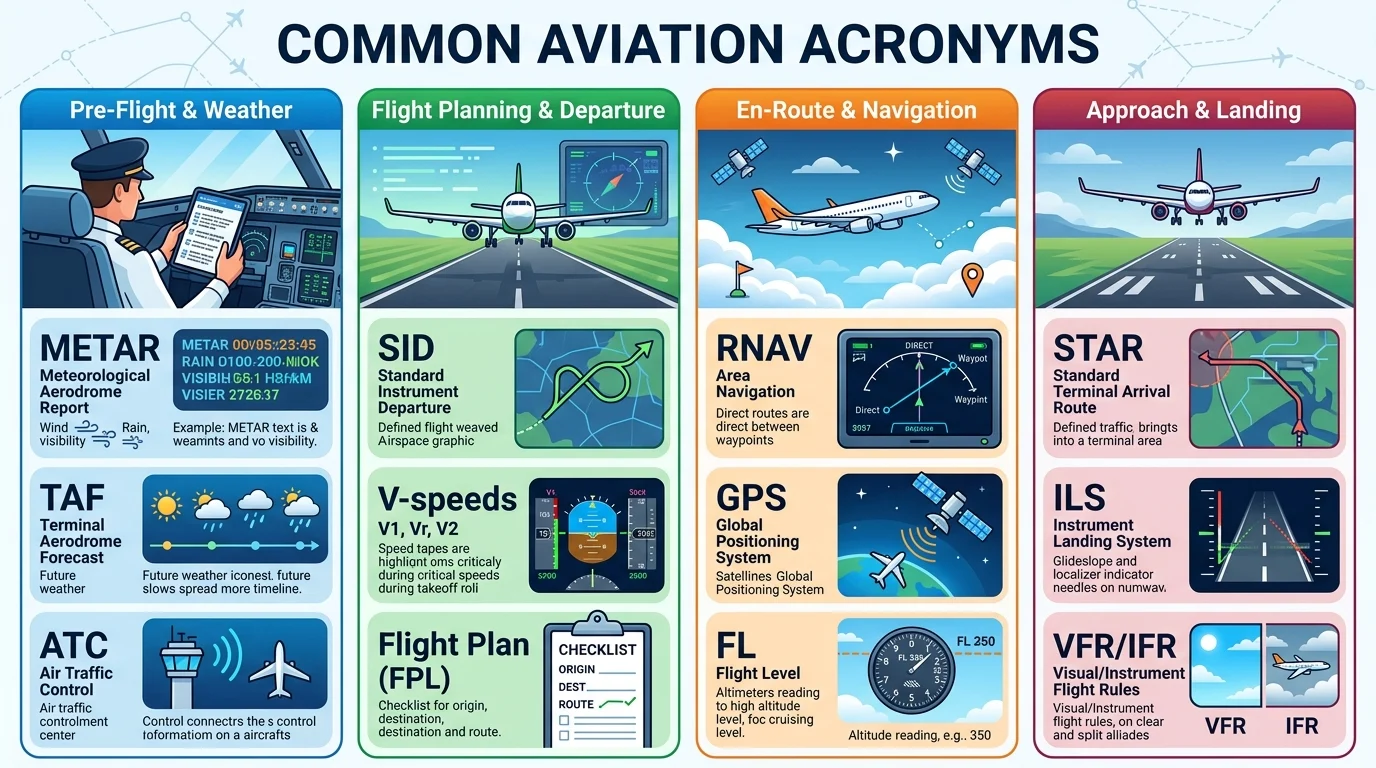
If you look at the aviation world, you will notice something very interesting. Almost everything is written in short forms. From cockpit instruments to airport operations, pilots, air traffic controllers, and engineers all use aviation acronyms every day.
For someone new, these short forms can feel confusing. You might see letters like ATC, ETA, or VFR and wonder, What do they mean?
The reason is simple: aviation is a global industry where clear and fast communication is very important. Acronyms help pilots and staff communicate quickly without mistakes.
In this guide, you will learn the most important aviation acronyms list, their full forms, and simple meanings so you can understand aviation language easily.
What Are Aviation Acronyms?
Aviation acronyms are short forms made from the first letters of aviation-related terms.
Simple Meaning:
They are shortcuts used in flying, airports, and aircraft systems to save time and improve safety.
For example:
- ATC = Air Traffic Control
- ETA = Estimated Time of Arrival
- VFR = Visual Flight Rules
These acronyms are used worldwide in aviation communication.
Why Aviation Uses So Many Acronyms
Aviation is a high-speed and high-safety industry. Even a small misunderstanding can cause serious problems.
Acronyms are used because:
- They save time
- They reduce communication errors
- They are used globally
- They are easy for pilots and controllers to understand
👉 In short: Aviation acronyms improve safety and speed.
✈️ Important Aviation Acronyms List
Here is a simple and useful list of common aviation acronyms:
1. ATC – Air Traffic Control
Meaning: Controls aircraft movement in the sky and on the ground
Used by: Airports and pilots
Example: “ATC cleared the plane for landing.”
2. ETA – Estimated Time of Arrival
Meaning: Expected time when an aircraft will reach destination
Example: “ETA is 3:45 PM.”
3. ETD – Estimated Time of Departure
Meaning: Expected time when flight will take off
Example: “ETD has been delayed.”
4. VFR – Visual Flight Rules
Meaning: Flying using visual reference outside the aircraft
Used when: Weather is clear
Example: Pilots fly under VFR in good weather.
5. IFR – Instrument Flight Rules
Meaning: Flying using cockpit instruments
Used when: Weather is bad or visibility is low
Example: “The flight is operating under IFR conditions.”
6. ALT – Altitude
Meaning: Height of an aircraft above sea level
Example: “Maintain ALT 10,000 feet.”
7. FBO – Fixed Base Operator
Meaning: Airport service provider (fuel, maintenance, parking)
Example: “The aircraft is parked at FBO.”
8. RNAV – Area Navigation
Meaning: GPS-based flight navigation system
Example: Used in modern aircraft navigation.
9. ILS – Instrument Landing System
Meaning: System that helps aircraft land safely in low visibility
Example: “ILS approach is active.”
10. ATIS – Automatic Terminal Information Service
Meaning: Recorded airport information for pilots
Example: Weather and runway updates.
11. METAR – Meteorological Aerodrome Report
Meaning: Weather report for aviation use
Example: “METAR shows clear weather conditions.”
12. TAF – Terminal Aerodrome Forecast
Meaning: Weather forecast for airports
Example: Used for flight planning.
13. SOP – Standard Operating Procedure
Meaning: Rules and procedures for pilots and crew
Example: Follow SOP for safety.
14. MRO – Maintenance, Repair, and Overhaul
Meaning: Aircraft maintenance services
Example: Aircraft sent for MRO check.
15. FMC – Flight Management Computer
Meaning: Computer system that controls flight operations
Example: Used for navigation and performance.
How Aviation Acronyms Are Used in Real Life
1. In Cockpit Communication
Pilots use acronyms to communicate quickly with ATC.
2. In Airport Operations
Ground staff use acronyms for scheduling and safety.
3. In Flight Planning
Weather reports, routes, and timing use acronyms like METAR and TAF.
4. In Training
New pilots learn acronyms as part of basic aviation education.
Common Mistakes with Aviation Acronyms
Many beginners make mistakes like:
- Confusing IFR and VFR
- Misunderstanding weather acronyms like METAR
- Not learning full forms before use
- Mixing aviation acronyms with general abbreviations
👉 In aviation, small mistakes can cause big problems, so accuracy is important.
Why Learning Aviation Acronyms Is Important
Understanding aviation acronyms helps because:
- It improves communication
- It increases flight safety
- It helps in pilot training
- It supports air traffic coordination
- It builds aviation knowledge
Simple Summary
- Aviation acronyms are short forms used in flying and airports
- They help improve safety and communication
- Common examples include ATC, ETA, IFR, VFR, METAR
- Each acronym has a specific meaning depending on context
Conclusion
The world of aviation depends heavily on acronyms. From pilots in the cockpit to air traffic controllers on the ground, these short forms make communication fast, safe, and clear.
Learning aviation acronyms is important for anyone interested in flying, airport operations, or aviation studies. Once you understand them, the complex language of aviation becomes much easier to follow.
In simple words:
Aviation acronyms are the language of the sky—short, clear, and essential for safe flying.


