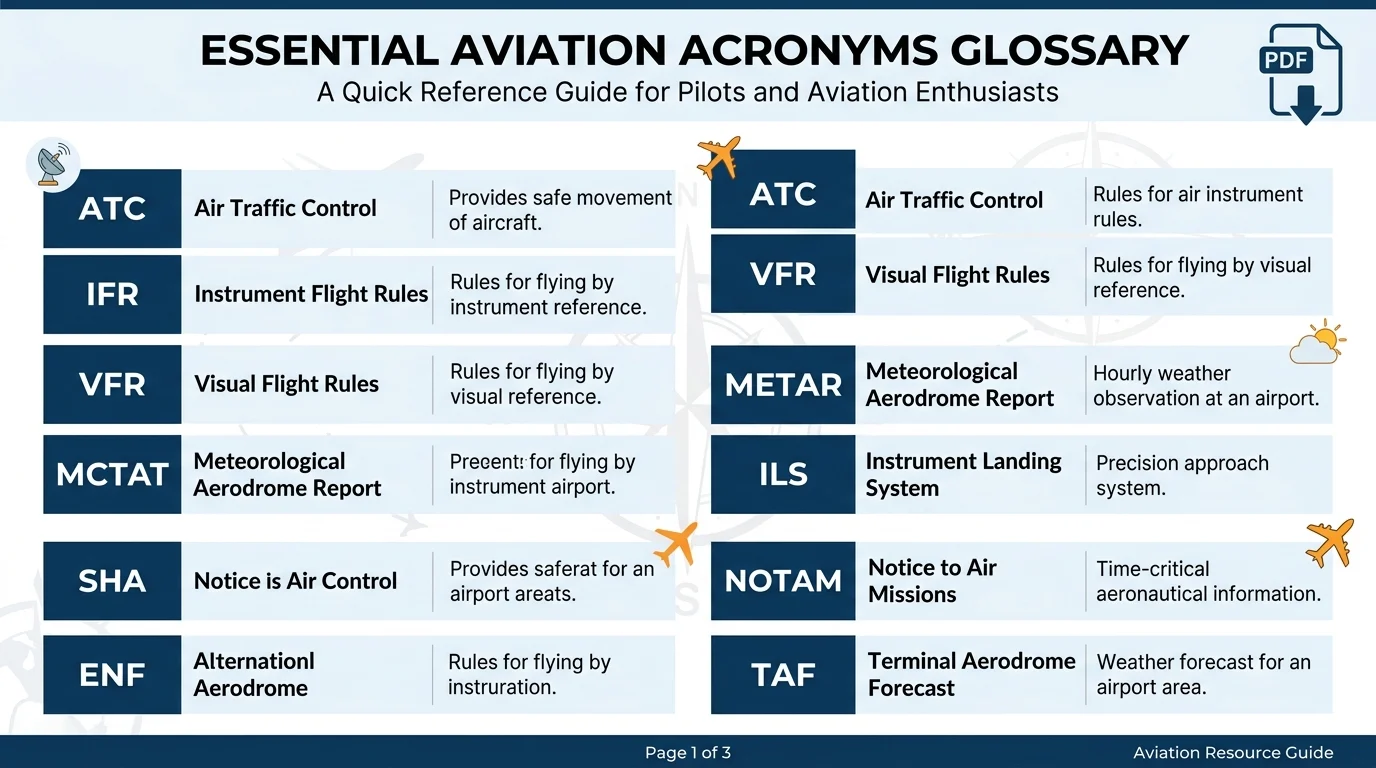
Aviation is a highly technical field where pilots, air traffic controllers, engineers, and airline staff use many aviation acronyms to communicate quickly and safely. These abbreviations are used in flight operations, navigation, weather reports, aircraft systems, and aviation safety.
If you are looking for an aviation acronyms PDF, it usually contains a list of commonly used terms for study, pilot training, or aviation exams.
What Are Aviation Acronyms?
Aviation acronyms are shortened forms of technical terms used in the aviation industry to improve speed, clarity, and safety in communication.
They are commonly used in:
- Pilot training
- Air traffic control (ATC)
- Flight operations
- Aircraft maintenance
- Aviation weather reports
- Aviation exams (PPL, CPL, ATPL)
For example:
- ATC = Air Traffic Control
- VFR = Visual Flight Rules
- IFR = Instrument Flight Rules
Common Aviation Acronyms List (PDF Content Style)
| Acronym | Full Form | Meaning |
|---|---|---|
| ATC | Air Traffic Control | Controls aircraft movement |
| IFR | Instrument Flight Rules | Flying using instruments |
| VFR | Visual Flight Rules | Flying using visual conditions |
| PPL | Private Pilot License | Basic pilot certification |
| CPL | Commercial Pilot License | Professional pilot license |
| ATPL | Airline Transport Pilot License | Highest pilot license |
| VOR | VHF Omnidirectional Range | Navigation system |
| ILS | Instrument Landing System | Precision landing aid |
| FMS | Flight Management System | Aircraft navigation computer |
| FMC | Flight Management Computer | Flight data system |
| METAR | Meteorological Aerodrome Report | Airport weather report |
| TAF | Terminal Aerodrome Forecast | Weather forecast for airports |
| NOTAM | Notice to Airmen | Important flight notices |
| EASA | European Union Aviation Safety Agency | Aviation regulator |
| FAA | Federal Aviation Administration | US aviation authority |
Pilot Training Acronyms
PPL (Private Pilot License)
Basic license allowing private flying.
CPL (Commercial Pilot License)
Allows pilots to fly for commercial airlines.
ATPL (Airline Transport Pilot License)
Highest level of pilot certification.
Navigation Acronyms
VOR
Used for aircraft navigation using radio signals.
ILS
Helps aircraft land safely in poor visibility.
FMS
Computer system that manages flight routes and fuel.
Weather Acronyms in Aviation
METAR
Real-time weather report at airports.
TAF
Forecast of weather conditions for airports.
NOTAM
Important alerts for pilots about airspace changes or hazards.
Aviation Safety Authorities
FAA
The Federal Aviation Administration controls civil aviation safety in the United States.
EASA
The European Union Aviation Safety Agency regulates aviation safety across Europe.
Why Aviation Acronyms Are Important
Aviation acronyms are essential because they:
- Improve communication speed
- Reduce errors in flight operations
- Ensure safety in air traffic control
- Standardize global aviation procedures
- Help pilots understand technical systems
Common Mistakes with Aviation Acronyms
1. Confusing IFR and VFR
They represent different flight rules.
2. Misreading weather reports
METAR and TAF have different purposes.
3. Mixing navigation systems
VOR and ILS serve different functions.
Real-Life Examples
Pilot Communication
“Flight cleared under IFR conditions.”
Weather Report
“METAR indicates low visibility.”
Air Traffic Control
“Contact ATC for landing clearance.”
Simple Memory Guide
- ATC = Air traffic control
- IFR = Instrument flying
- VFR = Visual flying
- METAR = Weather report
- NOTAM = Flight alert
- ILS = Landing system
Final Summary
An aviation acronyms PDF typically includes essential pilot and airline terms such as ATC, IFR, VFR, METAR, NOTAM, ILS, and FMS. These acronyms are critical for safe flight operations, navigation, communication, and aviation safety.
Understanding these terms is essential for pilots, aviation students, and airline professionals working in the global aviation industry.


