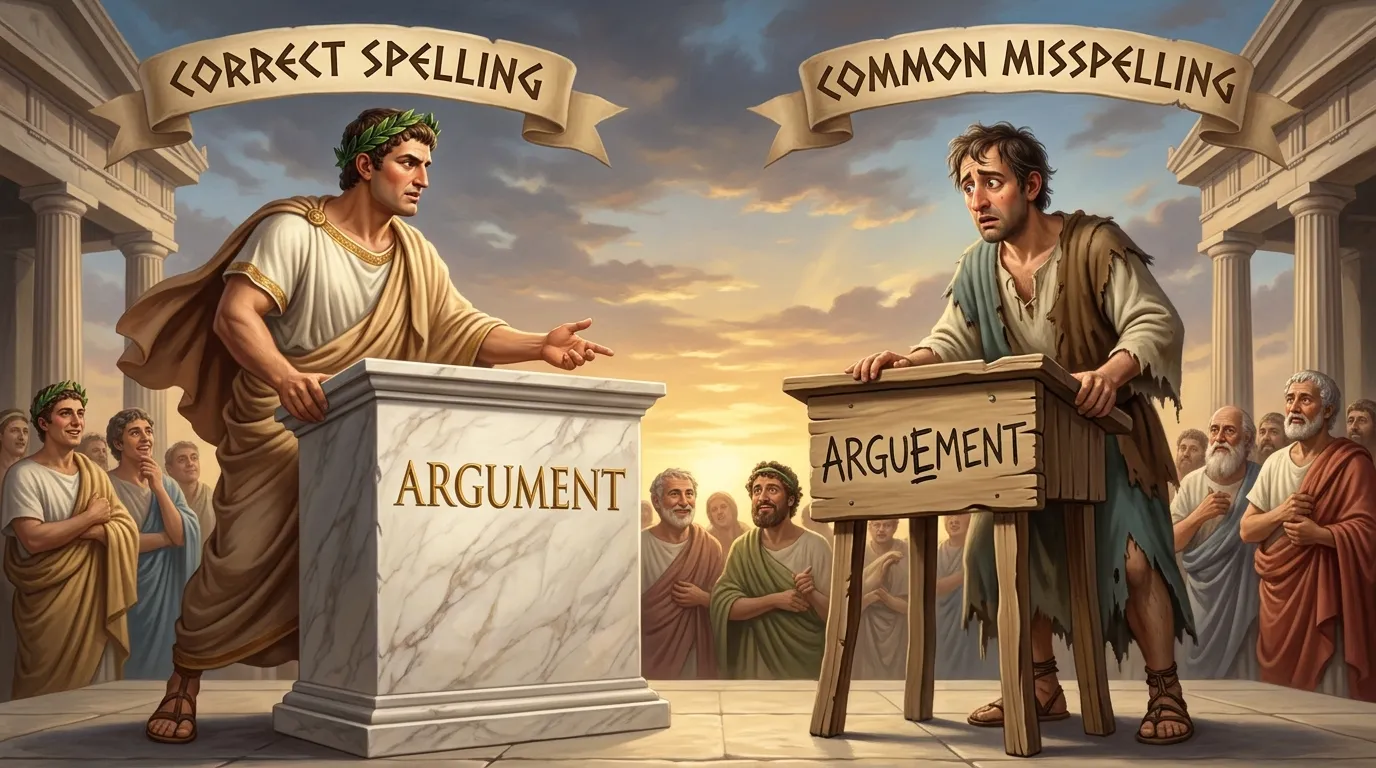
Many English learners, students, and even native speakers wonder whether the correct spelling is argument or arguement. Because the two spellings look very similar, it’s easy to make a mistake. However, only one spelling is correct in standard English. The correct spelling is argument, while arguement is a common misspelling.
The word argument is widely used in conversations, academic writing, business communication, legal documents, debates, emails, and everyday English. It can refer to a disagreement between people or a reason or point presented to support an opinion. Whether you’re writing an essay, discussing a topic, or preparing for a debate, using the correct spelling is important. The spelling is the same in American English and British English, so there are no regional differences to remember.
Many people mistakenly write arguement because they assume the word should keep the “e” from the verb argue. However, when the noun argument is formed, the “e” is dropped. Learning the grammar rule, pronunciation, examples, etymology, and memory tricks will help you remember the correct spelling every time.
Quick Answer
| Word | Correct? |
|---|---|
| ✅ Argument | Correct |
| ❌ Arguement | Incorrect |
Argument means a disagreement, a discussion with opposing views, or a reason used to support an opinion.
Examples:
- We had an argument about money.
- She presented a strong argument in the meeting.
Arguement is not a correct English word.
What Does Argument Mean?
Argument is a noun.
It can mean:
- A disagreement or quarrel between people.
- A logical reason or statement used to support an opinion.
- A discussion where different viewpoints are presented.
Examples
- Their argument lasted for an hour.
- His argument was supported by strong evidence.
- The lawyer presented a convincing argument.
- We had an argument over the schedule.
Grammar Role of Argument
Argument functions as a noun.
Types of Arguments
- Personal argument
- Legal argument
- Academic argument
- Business argument
- Political argument
Common Expressions
- Strong argument
- Logical argument
- Heated argument
- Winning argument
- Main argument
- Argument against
- Argument for
Argument in American English
American English always uses argument.
Examples
- We had an argument yesterday.
- Her argument was convincing.
- The lawyer made a strong argument.
- I understand your argument.
- The article presents a clear argument.
Argument in British English
British English also uses argument.
Examples
- Their argument became quite heated.
- She made a persuasive argument.
- The debate included several strong arguments.
- We had an argument over the bill.
- His argument was well supported.
There is no spelling difference between UK and US English.
Argument vs Arguement Comparison Table
| Feature | Argument | Arguement |
|---|---|---|
| Correct spelling | ✅ Yes | ❌ No |
| Dictionary word | Yes | No |
| Meaning | Disagreement or reason supporting an opinion | No meaning |
| Grammar | Noun | Incorrect spelling |
| American English | Correct | Incorrect |
| British English | Correct | Incorrect |
| Professional writing | Recommended | Never use |
Pronunciation Guide
Argument
IPA (UK): /ˈɑːɡ.jə.mənt/
IPA (US): /ˈɑːrɡ.jə.mənt/
Pronounced:
AR-gyuh-ment
Although it comes from argue, the spelling does not include the letter “e” after u.
Why Do People Confuse Argument and Arguement?
People often write arguement because:
- The base verb is argue.
- They incorrectly keep the “e” when forming the noun.
- The pronunciation doesn’t clearly reveal the spelling.
- Fast typing can lead to this common mistake.
Remember:
Argue → Argument
The “e” is removed before adding -ment.
Word Origin and Etymology
The word argument comes from the Latin word argumentum, meaning proof, evidence, or reasoning. It entered English through Old French and has been used for centuries to describe both logical reasoning and disagreements.
Although argument comes from argue, the spelling changed during its historical development, which is why the noun does not keep the “e.”
Argument Synonyms
| Synonym | Meaning |
|---|---|
| Dispute | A disagreement |
| Debate | A formal discussion |
| Quarrel | A heated disagreement |
| Discussion | Exchange of ideas |
| Reasoning | Logical thinking |
| Evidence | Support for an idea |
| Claim | A statement or assertion |
American English Preferences
- Argument
- Debate
- Dispute
British English Preferences
- Argument
- Discussion
- Debate
Argument vs Related Words
| Word | Meaning |
|---|---|
| Argue | Verb |
| Argument | Noun |
| Debate | Formal discussion |
| Discussion | Exchange of ideas |
| Dispute | Disagreement |
Examples:
- They argue every week.
- Their argument ended quickly.
- We had a productive discussion.
Grammar Rule Behind Argument
The base verb is:
Argue
When forming the noun:
Argue → Argument
The final “e” is removed before adding -ment.
Do not write arguement.
Common Mistakes and Corrections
1. Writing Arguement
❌ We had an arguement.
✅ We had an argument.
2. Keeping the Silent “E”
❌ Arguement
✅ Argument
3. Incorrect Email
❌ Your arguement is valid.
✅ Your argument is valid.
4. Wrong School Assignment
❌ Present your arguement.
✅ Present your argument.
5. Incorrect Business Report
❌ His arguement convinced the team.
✅ His argument convinced the team.
6. Social Media Mistake
❌ Stop the arguement.
✅ Stop the argument.
7. Resume or Presentation Error
❌ Build a strong arguement.
✅ Build a strong argument.
Real-Life Examples
Emails
- Thank you for explaining your argument.
- Your argument is well supported.
Office
- She presented a convincing argument.
- We discussed both sides of the argument.
School
- Write an argument based on evidence.
- His argument earned high marks.
Business
- The manager accepted her argument.
- Their argument focused on customer satisfaction.
Social Media
- The argument quickly went viral.
- Avoid unnecessary arguments online.
Everyday Conversation
- We had an argument yesterday.
- His argument makes sense.
American English Example Sentences
- We had an argument about work.
- Her argument was persuasive.
- The lawyer presented a strong argument.
- I understand your argument.
- His argument changed my opinion.
- They avoided another argument.
- The debate included every argument.
- She supported her argument with facts.
- It became a heated argument.
- His argument was logical.
British English Example Sentences
- Their argument lasted all evening.
- She made an excellent argument.
- His argument was carefully prepared.
- We avoided an argument.
- The argument centred on education.
- Her argument was persuasive.
- The discussion became an argument.
- Every argument needs evidence.
- They settled the argument peacefully.
- It was a thoughtful argument.
Memory Tricks to Remember Argument
1. Drop the Silent “E”
Argue → Argument
2. Think of “Ment”
Add -ment, not -ement.
3. Remember the Rule
Many words ending in -e drop the “e” before certain suffixes.
4. Use the Phrase
“A strong argument wins debates.”
5. Write It Three Times
Argument
Argument
Argument
Frequently Asked Questions
Is argument or arguement correct?
Argument is correct.
What does argument mean?
It means a disagreement or a reason supporting an opinion.
Is arguement a word?
No.
How do you spell argument?
A-R-G-U-M-E-N-T
Is argument used in British English?
Yes.
Is argument used in American English?
Yes.
How do you pronounce argument?
AR-gyuh-ment
Is argument a noun?
Yes.
What are synonyms of argument?
Debate, dispute, discussion, reasoning, and quarrel.
Why isn’t it spelled arguement?
Because the “e” from argue is dropped before adding -ment.
People Also Ask
Why do people spell argument as arguement?
Because they mistakenly keep the silent “e” from the verb argue.
Is argument spelled differently in the UK and the US?
No.
Both varieties use argument.
What is the grammar rule for argument?
Drop the final “e” from argue before adding -ment.
Is argument formal or informal?
It is used in both formal and informal English.
Conclusion
Understanding the difference between argument or arguement is simple once you know the spelling rule. Argument is the only correct spelling, while arguement is a common misspelling caused by incorrectly keeping the silent “e” from argue.
The word argument is commonly used in education, business, law, debates, emails, and everyday conversations to describe either a disagreement or a reason supporting an opinion. Since American English and British English use the same spelling, you only need to remember one correct form.
A simple memory trick is “Argue drops the E before becoming argument.” Think argue → argument, not arguement. By remembering this rule and practicing the correct spelling, you’ll improve your English writing and avoid one of the language’s most common spelling mistakes.


