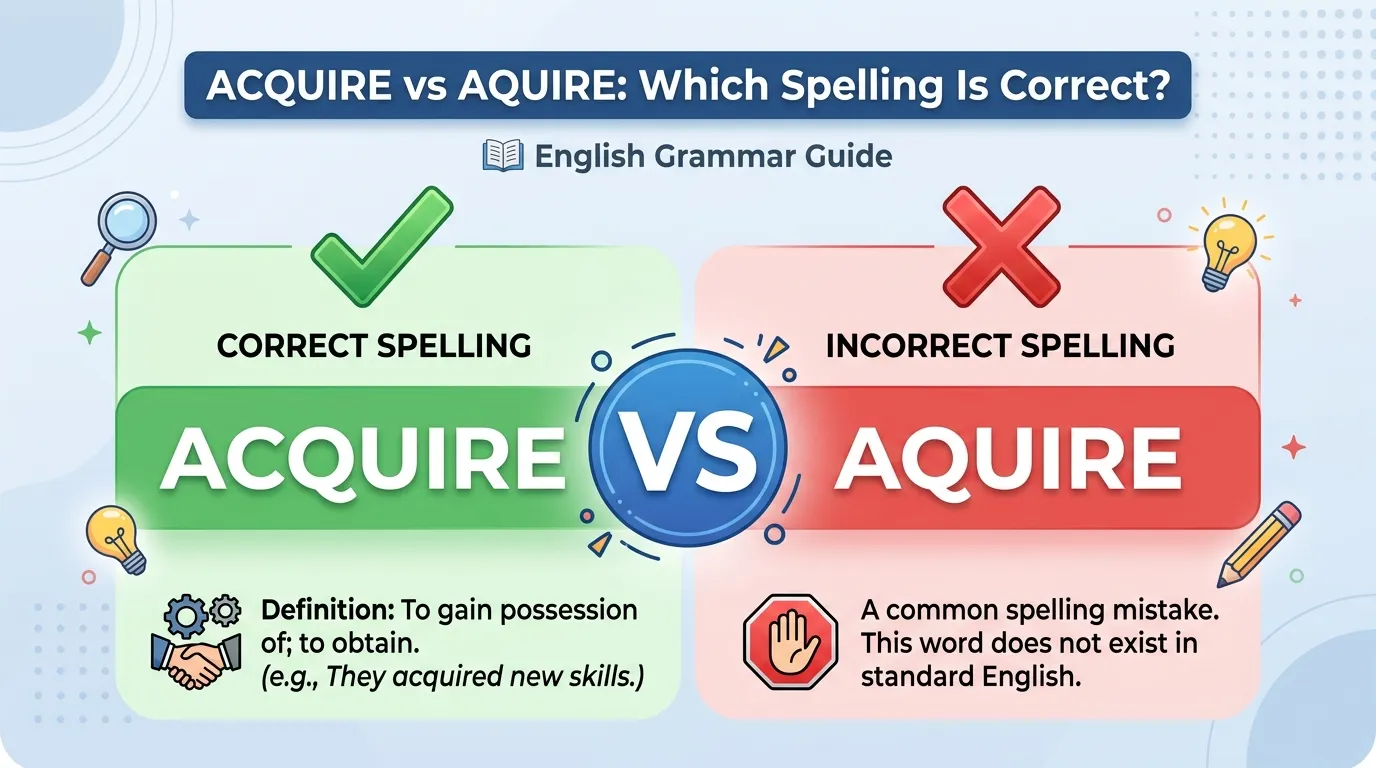
When comparing acquire vs aquire, the answer is simple: acquire is the correct spelling, while aquire is a misspelling. Despite this, many people accidentally type or write aquire because English spelling rules can be confusing, especially when words contain the letter combination “cqu.”
If you’ve ever wondered whether aquire is an accepted spelling or why spell check keeps correcting it, you’re not alone. Thousands of people search for this question every month.
In this guide, you’ll learn:
- The correct spelling and pronunciation
- Why people confuse acquire and aquire
- The meaning of acquire
- Grammar and usage rules
- American vs British English differences
- Memory tricks to avoid mistakes
- Common examples and corrections
- Professional writing recommendations
- Frequently asked questions
By the end, you’ll know exactly when and how to use acquire with confidence.
Quick Answer
| Word | Correct? | Meaning |
|---|---|---|
| Acquire | ✅ Yes | To get, obtain, gain, or develop something |
| Aquire | ❌ No | Incorrect spelling of acquire |
Correct: I want to acquire new skills.
Incorrect: I want to aquire new skills.
Is It Acquire or Aquire?
The only correct spelling is acquire.
The word always contains the letter c after the a, forming the sequence:
a + c + q + u + i + r + e
Many writers accidentally remove the c, creating aquire, but dictionaries do not recognize it as a correct English word.
Whether you’re writing an email, school paper, blog post, business proposal, or academic article, you should always use acquire.
What Does Acquire Mean?
Acquire is a verb.
Dictionary Definition
Acquire (verb)
To gain, obtain, buy, develop, learn, or come into possession of something.
The thing you acquire may be:
- Knowledge
- Skills
- Experience
- Property
- Wealth
- Equipment
- Companies
- Habits
- Languages
- Customers
Examples
- She acquired valuable leadership skills.
- The company acquired a smaller competitor.
- Children acquire language naturally.
- We acquired the property last year.
- He acquired extensive experience overseas.
Why Do People Spell It “Aquire”?
This mistake happens because English pronunciation does not clearly emphasize the hidden c.
People hear:
uh-KWIRE
Instead of seeing:
acquire
Another reason is that many English words beginning with a do not contain the cqu letter pattern.
For example:
- adequate
- aquatic
- aquarium
As a result, many people mistakenly assume acquire follows the simpler spelling pattern.
How to Pronounce Acquire
IPA (American English):
/əˈkwaɪr/
Sounds like:
uh-KWIRE
Rhymes with:
- fire
- wire
- hire
- choir (approximately)
The pronunciation remains the same in both American and British English.
Acquire vs Aquire: Side-by-Side Comparison
| Feature | Acquire | Aquire |
|---|---|---|
| Correct spelling | ✅ Yes | ❌ No |
| Dictionary word | Yes | No |
| Part of speech | Verb | None |
| Used in formal writing | Yes | No |
| Used in business | Yes | No |
| Used in academic writing | Yes | No |
| Accepted worldwide | Yes | No |
Why Does Acquire Contain “CQ”?
The spelling comes from Latin.
The word developed from:
Latin
acquirere
Meaning:
to gain, add to, obtain
Over time it entered Old French before becoming part of Middle English.
The cq spelling has been preserved throughout its history.
Word History and Etymology
The history of acquire explains why its spelling looks unusual.
Latin
acquirere
Meaning:
- add to
- gain
- obtain
↓
Old French
acquerre
↓
Middle English
acquire
↓
Modern English
acquire
The unusual cqu combination is inherited from Latin rather than created by modern English spelling.
What Does Acquire Mean in Different Contexts?
The verb changes slightly depending on the situation.
Business
Companies often acquire other businesses.
Example:
- Microsoft acquired several technology companies.
Education
Students acquire knowledge.
Example:
- Reading helps children acquire vocabulary.
Employment
Workers acquire experience.
Example:
- She acquired management experience during her internship.
Real Estate
People acquire property.
Example:
- They acquired farmland outside the city.
Finance
Investors acquire assets.
Example:
- The fund acquired additional shares.
Technology
Organizations acquire software.
Example:
- The company acquired a cybersecurity platform.
Medicine
People acquire diseases or immunity.
Example:
- He acquired immunity after recovering.
Example:
- Some infections are acquired in hospitals.
Common Collocations with Acquire
These combinations appear frequently in English.
Acquire knowledge
Students acquire knowledge through study.
Acquire experience
New employees acquire experience over time.
Acquire skills
Practice helps athletes acquire new skills.
Acquire property
Families often acquire homes.
Acquire wealth
Successful businesses may acquire wealth gradually.
Acquire customers
Companies work hard to acquire new customers.
Acquire assets
Investors acquire assets to build long-term value.
Acquire confidence
Practice helps speakers acquire confidence.
Acquire permission
You must acquire permission before entering.
Acquire a reputation
He acquired a reputation for honesty.
Synonyms of Acquire
Depending on context, acquire may mean:
- obtain
- gain
- earn
- collect
- gather
- secure
- receive
- develop
- learn
- pick up
- build
- attain
- achieve
- procure
- win
Antonyms of Acquire
Common opposites include:
- lose
- surrender
- abandon
- give away
- discard
- forfeit
- relinquish
- sell
- miss
Related Words
The same word family includes:
- acquisition
- acquisitive
- acquirer
- acquired
- acquiring
- reacquire
Examples:
- The acquisition was completed yesterday.
- She is acquiring new qualifications.
- They reacquired the property.
Grammar Guide
Acquire is a regular verb.
| Tense | Form |
|---|---|
| Base | acquire |
| Present | acquire / acquires |
| Past | acquired |
| Past participle | acquired |
| Present participle | acquiring |
Examples:
- I acquire new skills.
- She acquires customers quickly.
- They acquired the company.
- We have acquired enough evidence.
- He is acquiring confidence.
American vs British English
There is no spelling difference between American and British English.
| American English | British English |
|---|---|
| acquire | acquire |
Unlike words such as:
- color / colour
- organize / organise
Acquire stays exactly the same in every major English-speaking country.
Formal vs Informal Usage
Acquire is appropriate almost everywhere.
Formal
- The university acquired additional research funding.
- The organization acquired new equipment.
Informal
- I finally acquired a decent coffee maker.
- He acquired a new hobby during the holidays.
Academic Writing
Acquire is extremely common in academic English.
Examples:
- Children acquire language through interaction.
- Researchers acquired the necessary data.
- Students acquire analytical skills over time.
Business Writing
Acquire is frequently used in business communication.
Examples:
- We plan to acquire additional office space.
- The company hopes to acquire more customers.
- Investors acquired significant holdings.
Journalism
News organizations commonly use acquire when reporting business stories.
Example:
- The retailer acquired its competitor for $2 billion.
Technical Writing
Examples:
- The sensor acquires data every second.
- The software acquires information from multiple sources.
Sports Usage
Athletes and teams also use acquire.
Examples:
- The club acquired a new striker.
- The team acquired experienced defenders.
Everyday Examples
Here are common conversations using acquire naturally.
- I want to acquire better cooking skills.
- She acquired confidence after practicing.
- We acquired our first home last year.
- He acquired a taste for spicy food.
- They acquired new office furniture.
Literal and Figurative Meanings
Literal
Receiving something physical.
Example:
- They acquired new computers.
Figurative
Developing something intangible.
Example:
- She acquired patience over the years.
Common Expressions Using Acquire
Many English expressions use the word naturally.
- acquire knowledge
- acquire experience
- acquire confidence
- acquire wealth
- acquire property
- acquire citizenship
- acquire influence
- acquire power
- acquire new habits
- acquire expertise
Common Mistakes
Mistake 1
❌ I want to aquire more experience.
✅ I want to acquire more experience.
Mistake 2
❌ We aquired new equipment.
✅ We acquired new equipment.
Mistake 3
❌ She is aquiring new skills.
✅ She is acquiring new skills.
Mistake 4
❌ The company plans to aquire another business.
✅ The company plans to acquire another business.
Awkward vs Natural Examples
| Awkward | Natural |
|---|---|
| I acquired happiness yesterday. | I found happiness yesterday. |
| He acquired a smile. | He smiled. |
| We acquired breakfast. | We bought breakfast. |
| She acquired friends. | She made friends. |
| I acquired sleep. | I got some sleep. |
Although acquire is correct, simpler verbs are often more natural in casual conversation.
When Should You Use Simpler Alternatives?
Sometimes another verb sounds smoother.
| Instead of | Consider |
|---|---|
| acquire food | buy food |
| acquire friends | make friends |
| acquire sleep | get sleep |
| acquire coffee | buy coffee |
| acquire clothes | buy clothes |
Use acquire when emphasizing obtaining, gaining, or developing something, especially in formal or professional contexts.
Memory Trick to Remember the Correct Spelling
Think of this pattern:
ACQUIRE contains CQ.
Remember:
Companies Acquire Quality.
The initials are:
CQ
This reminds you that the c always comes before q.
Another easy trick:
If you remember the word acquisition, you’ll automatically remember acquire, since both share the same acqui- beginning.
Is “Aquire” Ever Correct?
No.
Modern dictionaries classify aquire as a spelling mistake.
Spell-check software, grammar checkers, publishers, universities, and professional editors all recommend acquire.
There are no accepted dialects of English where aquire is considered correct.
Should You Ever Use “Aquire”?
No.
Avoid using it in:
- School assignments
- College essays
- Business emails
- Research papers
- Websites
- Blogs
- Books
- News articles
- Technical documents
- Social media posts where professionalism matters
Always replace it with acquire.
Best Practices for Different Types of Writing
| Writing Type | Recommended Usage |
|---|---|
| American English | acquire |
| British English | acquire |
| International English | acquire |
| Academic papers | acquire |
| Business documents | acquire |
| Technical manuals | acquire |
| Journalism | acquire |
| Blogging | acquire |
| Professional emails | acquire |
| Casual writing | acquire |
The recommendation is the same across every writing style.
Final Comparison
| Feature | Acquire | Aquire |
|---|---|---|
| Correct English | ✅ | ❌ |
| Found in dictionaries | ✅ | ❌ |
| Professional writing | ✅ | ❌ |
| Academic writing | ✅ | ❌ |
| Business writing | ✅ | ❌ |
| Search engine recommended | ✅ | ❌ |
Frequently Asked Questions
Is “aquire” a real English word?
No. Aquire is not recognized as a standard English word. It is a common misspelling of acquire.
Which spelling is correct: acquire or aquire?
Acquire is the only correct spelling in modern English.
Why do people write “aquire”?
People often omit the c because the pronunciation does not make the c obvious, and the cqu letter combination is uncommon.
Is “aquire” accepted in British English?
No. British English also uses acquire.
Is “acquire” a noun or a verb?
Acquire is a verb. The related noun is acquisition.
What is the past tense of acquire?
The past tense is acquired.
Example:
- She acquired valuable experience.
What is the difference between acquire and obtain?
Both mean “to get something,” but acquire often suggests gaining something over time, through effort, learning, purchase, or development. Obtain usually emphasizes successfully getting something, regardless of the method.
Can you acquire skills?
Yes. This is one of the most common uses of the verb.
Example:
- She acquired excellent communication skills.
Is acquire formal?
It is slightly more formal than words like get or buy, but it is appropriate in both formal and everyday writing.
How can I remember the correct spelling?
Remember that acquire starts with acqui-, just like acquisition. If you can spell acquisition, you’ll be much less likely to write aquire.
Conclusion
The debate over acquire vs aquire has a clear answer: acquire is the correct spelling, while aquire is simply a common misspelling. The confusion usually comes from pronunciation and the unusual cqu letter pattern inherited from Latin, but standard English has always kept the c.
Whether you’re writing an academic paper, business email, blog post, news article, or social media update, always choose acquire. It is the accepted spelling in American English, British English, and other major varieties of English. When in doubt, remember its connection to acquisition—both words share the same acqui- beginning. Using the correct spelling will make your writing clearer, more professional, and more credible.


